
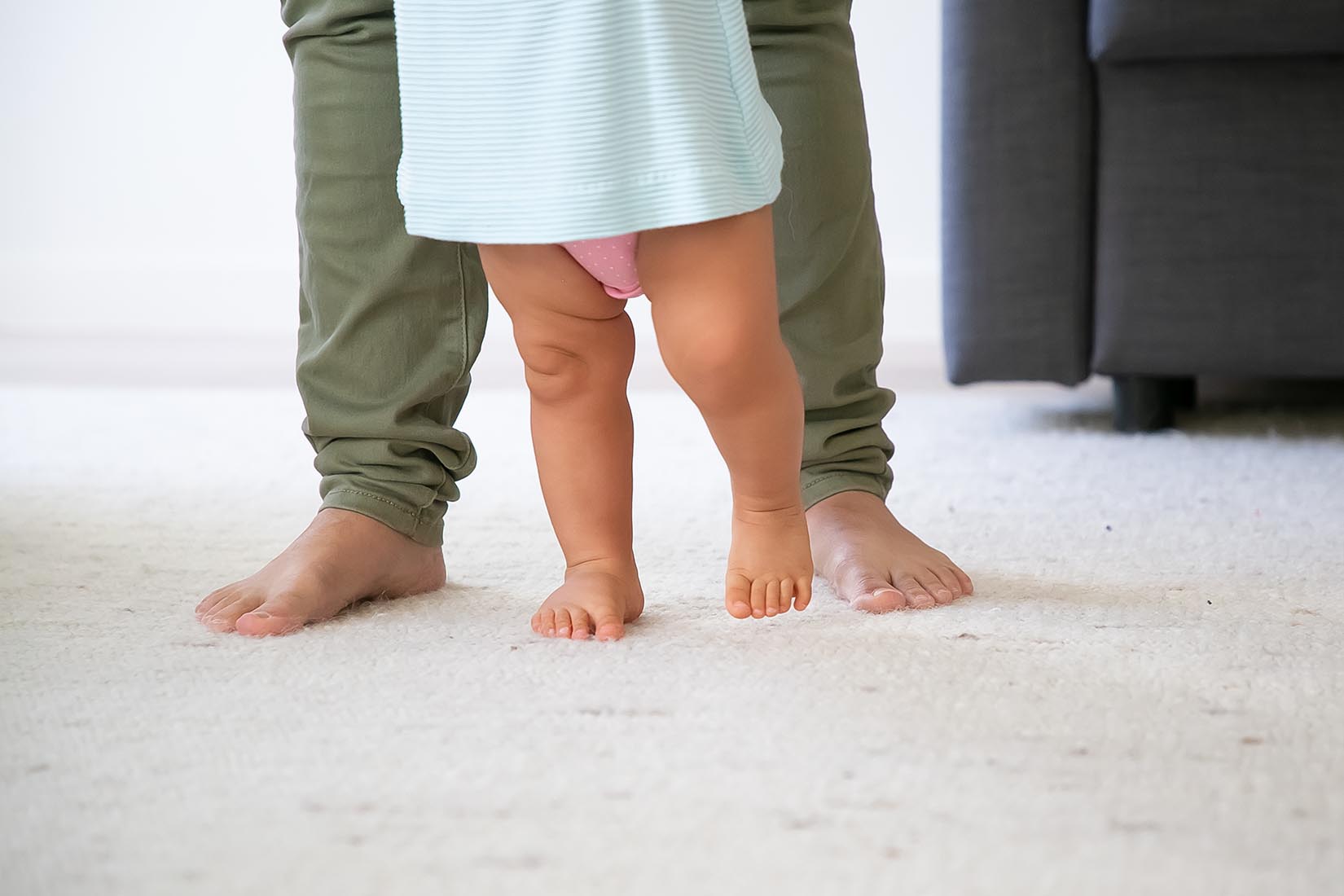
Baby milestones are something that all parents look forward to. In fact, they definitely make it a point to click pictures or record videos of those magical moments which fill them with the bitter-sweet emotions that their bundle of joy is growing up a little with each passing day.
First tooth, the first time he rises up on his belly, his turning around, first steps, first laughter and the list goes on.
They wish if they could freeze the time somehow!
There is one baby milestone that is not much spoken of or emphasized upon but plays a pivotal role in your child’s future handwriting, grasping pencils, moving their hands across the stomach to hold their bottles or even reading left to write as they enter school. Can you guess what are we referring to here?
Well, we are referring to crossing the midline. Never heard of it? No need to worry as we have got you covered.
Just like the Earth is spinning around an imaginary axis that passes through its center, humans also have an imaginary line that passes vertically through the center of our bodies. Surprised? Well, nature is all about symmetry after all. The terms ‘Crossing the midline’ refer to the skill of moving one’s limbs; hands or leg across this invisible line passing vertically through the navel or the center of the body to the other side. It is this ability that makes us move one hand, foot, or eye into the space of the other hand, foot or eye. We cross midline when we scratch an elbow, cross our ankles, and read left to right. This is critical in the development of fine and gross motor skills of human beings even for later on in life.
Usually, crossing the midline can be seen after 6 months of age as a baby begins to explore the world around them through the tactile senses (touch information). We are that sure your pediatrician has asked you about the baby crossing hands and legs? They begin to transfer objects from one side to the other or look at you as you move from one side of the room to the other. While doing so, they are crossing the midline unknowingly. Full understanding of crossing the midline however occurs by the age of 8-9.
What does it take to cross the midline?-The Science behind it
- Bilateral integration skills: This refers to the ability to use both hands/both legs simultaneously in sync with one another.
- Trunk rotation and a strong core: The muscles of the belly and waist need to be strong so as to supplement the movement of hands and legs controllably.
- A dominant limb: Improvising on the skills of a dominant hand and a leg is important for conquering fine motor skills like writing, playing etc.
- Continuity and sequencing: The ability to follow multi-step instructions to achieve a defined outcome like reading a line from left to right continuously as we read each letter.
- Control of body signals: The signals sent by our muscles and joints in action to our brain that helps us in alignment and posture
Why is crossing the midline important?
- It helps in development of a strong yet natural bent towards one hand by enabling the preferred hand to practice on both sides of the body as it crosses over the midline. This also allows the baby to fully explore the environment by crossing over to get hold of a toy with one hand whilst the other is occupied.
- It affects one’s ability to read and write. We read and write from the left to right side of the paper, crossing the page with our eyes in a continuous movement. For doing so without hassle, crossing the midline smoothly during the early years is indispensable.
- It is essential for various motor and cognitive skills. Failure at mastering this ability can lead to inability in effectively completing self-care skills and participating in sports & physical activities as children are not able to let both sides of their bodies form a relationship and work together.
For enabling your baby to cross the much needed midline, it is important:
- To let infants move as freely as possible and not restrain its movements by curling them up in baby wraps.
- To not let babies spend prolonged time periods sitting idle, for instance in baby gears, or screens. This inhibits the opportunities for infants to move around which would otherwise hone bimanual reaching and crossing the midline.
- To let infants move about his trunk (trunk rotation) i.e about his waist to help in crossing the midline. This way you are actually helping it to stabilize the muscles of hips, torso and shoulders (core), coordinate and sync the left and right side of the body simultaneously (bilateral coordination), become aware of his body and establish a dominant hand that is crucial for crossing the midline.
Not able to cross the midline?-Midline crossing inhibitions
Sometimes, children exhibit problems in crossing the midline. Incidences like
- Constantly switching hands between activities and tools like scribbling, painting, using crayons, scissors etc. This is due to lack of “preferred hand” development
- Inefficiency in picking up a toy from across the other side of the body
- Not able to reach for an object while creeping/crawling, unable to hold the bottle with both hands to feed itself
- A baby not able to respond to a parent standing away on the opposite side,
- Preschoolers/K12 unable to keep a track of the words in a line,
- As adults unable to type on a keyboard using both hands.
- Switching hands to play badminton or legs to play soccer etc. can reflect that they have difficulty in switching limbs and using them together or even crossing their own body.
Basically, their gross and fine motor skills along with bilateral limb coordination seems off. Both sides of their brains are not communicating, resulting in decreased coordination, decreased motor control of movements and difficulties achieving higher level skills. The child can be seen hesitating or fearing any task involving them to move their limbs across on the other side and come up with compensatory acts to get away with the situation. Examples can be an object is kept on the other side of the pillar (left of the child) and instead of crossing their right hand to grab it, the child gets up and goes round about the pillar to pick it up with his right hand or a child turning his book sideways at 90 degrees to aid reading from left to right instead of the normal posture. Often, these children end up with two unskilled hands.
Having said this, we don’t want you to panic if your child has any of these issues as we have got a few activities lined up for you to your rescue. Read about what you can do help the midline shift in your child. Crossing boundaries-The midline shift
Go get ‘em!