
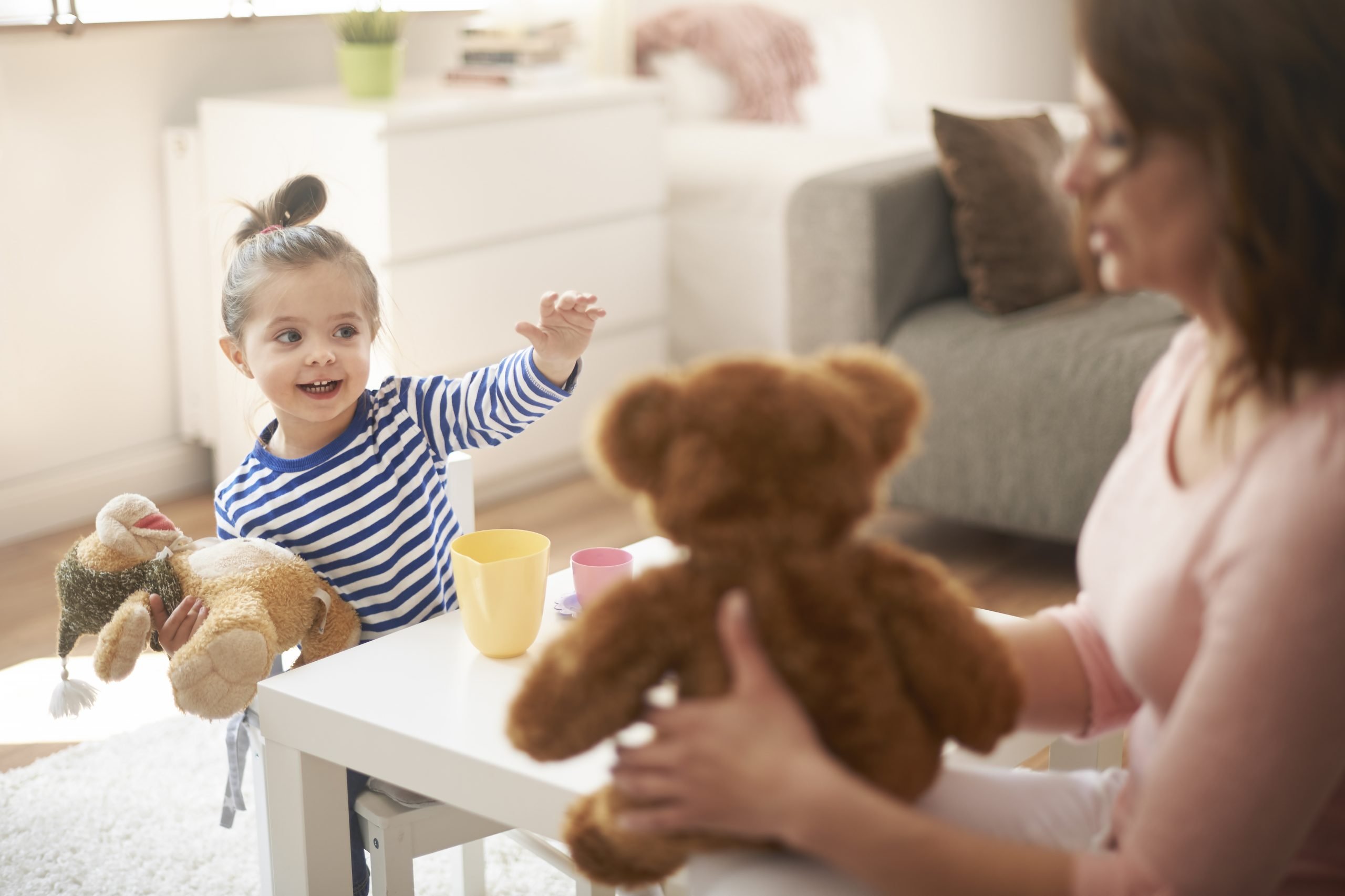
“I am a tea-cha today mumma, I do homm-a-ok”!
“Homm-a-ok?” the mother chuckled at his innocent stutter. “It is teacher and homework, Ansh”
“Homm-a-ok” he kept repeating as if he didn’t listen to the corrected pronunciation.
The mother smiled with a sigh. “Where did he pick these words from?” She wondered to herself.
Her 4 year was learning new words with his role-play every day!
Pretend play does not always have to be about just dressing up. It can be about zooming an old bottle around the room as if it were a racing car or a flying aeroplane/rockets too. But in any case, it allows children to communicate leaps and bounds as they often come out with words or phrases that we had no idea they knew!
Hi again, parents! As we have already discussed the details of pretend play, its benefits and tips in the previous blogs Ready Steady Pretend Play and Inside the drama , let’s take a closer look at the huge impact it can make on a child’s linguistic development.
Pretend play enables children to experiment with and learn about the power of language and how essential it is to propagate in their environment. It leads to a realization that words give them a medium to re-enact situations, mimic a teacher/doctor/firefighter/cartoon character/story book scene and put ideas across to make themselves heard and understood.
How can parents contribute to a child's linguistic development through pretend play?
- Try out games that have multiple characters so that you add to the vocabulary of your child by enacting ‘roles’ through play and stretching his imagination and creative play skills. Example: Setup a play of his favorite story where he plays his favorite character and your other family members take the remaining roles. Try to add multiple dialogues with new words in the story enactment and see how your child responds to them-either by repeating your words or imaginatively. You can include the following simple words:
Action words: Knocking/Chirping/hopping/jumping/drawing/skipping/cooking/driving/writing/brushing
Sensory words: Hot/Cold/Windy/smooth/rough//salty/sweet/slippery/smooth/rough/bumpy/splash/thunder/spicy/stinky
Emotions: Happy/curious/Upset/scared/bored/excited/sorry/surprised/joyous/merry/love/anger/
Adjectives:
Slow/Fast/Tall/Short/kind/understanding/brave/funny/cheerful/thoughtful/fearless
And the list goes on….
With gradual learning of new words and their usage, they pick up the context of usage and choice of words too. Yes, they learn that quickly!
- Let your child lead the game: Role Play (depending on your child's language competence) is a good idea when you just set the goal for each game. Do not to make it too structured because the purpose is to let the child lead.
Example- Playing acts like picnic, car wash, grocery vendor, ice-cream vendor, dollhouse with peers or family. This not only instills them with confidence in communicating but also, help broaden their horizon of imagination and make use of instances from daily life.
- Feed language into play and develop their listening skills: Hearing and making associations between the word and the action starts long before the speech milestone arrives. To be able to know or learn a word, children need to hear it first.
Parents, you must have noticed that children do not respond when usually asked about “what are you doing?” or “say hurry, say running, say this, say that”.
Children do not learn language this way. They first need to subconsciously hear what you say, to pick up those words instead of intentional mugging.
Just let it be fun and organic. A few examples can be:
- Drive the train: Let your child be a train driver and you can be the passenger. Set up some chairs in a column and act the roles. Hoot! Hoot! Use props like whistles, plates for steering wheels to make it more interactive. Use a lot of verbs while enacting the role for your child to listen and pick- Find your seat, Keep your luggage, greet the passengers, Show your ticket, Drive the train, Move in the tunnel, Look at the view outside etc.
If the child has trouble picking up initially, model it on yourself and show how to do it and then the child can repeat.
- Firefighting: Pretend the playhouse is on fire, and ask your child to get his fire truck and put out the fire and save the day!!
Now there is a huge scope to feed in a variety of words: fire engine, ladder, water, hose, burning, building, save, hurry, climbing, up, down, smoke, jackets, fire out, hero, siren, emergency etc.
- Role play to focus on speech and syllables: Practicing specific alphabet sounds is a good idea. For example, work on the /s/ or /r/sound for speech or literacy difficulties using a game involving a monster hunt and using as many /s/ or /r/ words in it e.g. save, swim, sun, supper, right, run, rough etc. After the game you can talk about all the words that start with the letter /s/ and /and model them again.
5. Social Interactions involve making eye-contact and significantly helps in development of listening skills, language skills, taking turns, etc. which are pivotal for communicating with the outside world.
Examples can be
- Excursion to zoo/safari: Give your child the feeling of an explorer with that hat and mini binoculars and dive into the world of animals. Let it learn new animal names. You could look for animals starting with a certain letter. Buy brochures/catalogues and make cut out of animals you saw and ask your child to guess, repeat and revise the names. Let it have a gala time with fellow children on the trip.
- Making a lemonade: Safe cooking sessions can be no less than an adventure for kids and can promote language in lots of ways. Pretend to be the chef with that hat and apron with your child. Capitalize on the language teaching opportunities by teaching it the name of all the ingredients-water, lemon, sugar, salt, ice. Use loads of verbs - stir, pour, freeze, fill, spread, weigh, squeeze, taste. You can also ask questions like “which ingredient begins with /l/”. Pretend to be ‘forgetful mommy’ and get your child to name the ingredient-
Mum: “Umm, what do I have to pour in the…… oh, what's it called….the…… “
Child: “Salt?”
Mum: “Salt, that's right” or “Where did I keep the sugar?”
Child: “Slab”
Mum: “Oh yes! You’re right”
Sometimes, just pretend to suddenly remember it and model it to them. Wink wink!
- Simple toys through which children can talk can be helpful (walkie-talkies, baby phones and mic): “Where are you, Captain?”
“Hiding behind the bushes”
“Do you want anything?”
“I want an ice cream, mommy”
“Aye, Captain! Roger that!”
Create pretend settings like a military zone, monster hunt, jungle and talk using new words through the device to sustain the fun level and learning simultaneously.
Use such tricks to infuse new words into the vocabulary of your toddler and see how his language ameliorates. You can thank us later!