
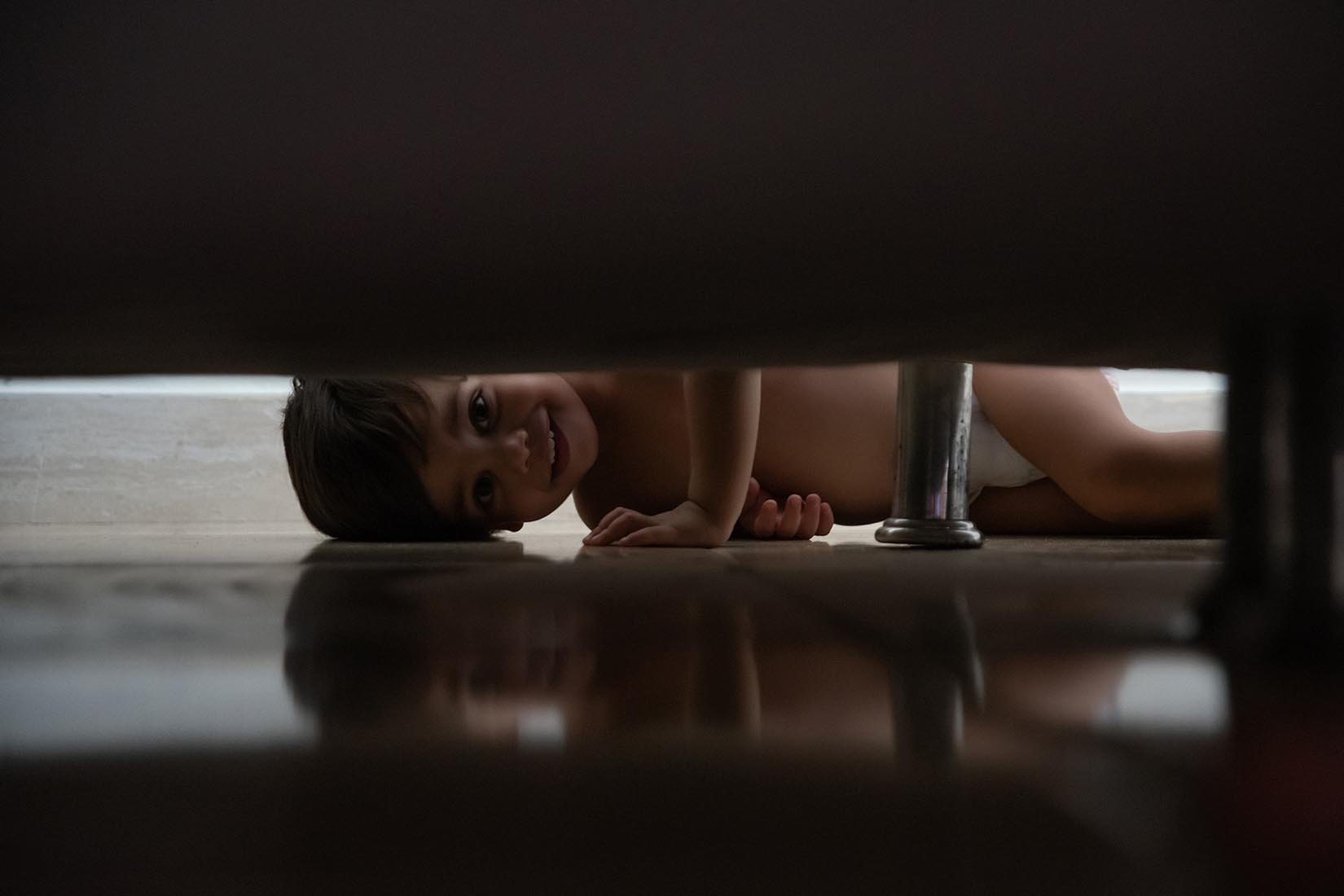
Fifteen-month-old Kavya was playing with a ball with her mother. Her one throw and the ball would bounce towards mommy. As they both played with it taking turns to throw it, suddenly the ball went under the bed. “Uh, oh!” mom exclaimed. Kavya, with her curious expressions, started to look here and there. “Ball go, mumma?” she said confusedly. She bent down trying to find it, searching each corner of the room. The mother enjoyed what her little one was actively doing and didn’t intervene purposely. Suddenly Kavya spotted the ball under the bed. “Look mumma, ball!” she remarked with joy, trying to reach it with her tiny hands. But the ball was beyond her reach. She went to the other room, got a bat and started to push the ball outside with it. And the ball was out! She started dancing with joy. Her mother was pleasantly surprised to see her idea float.
The curious case of toddlers
Infants and toddlers are natural scientists! You might have heard that before, but what does it really mean? Isn’t Kavya behaving in the same way a scientist behaves while conducting an ‘experiment’? The ball is under the bed, beyond her reach, she wants to get it out and must figure out how. She has a question: How can she get the ball out from under the bed? She makes a prediction—first, that she can take the ball out with her fingers. She tests that prediction and it fails. She makes more predictions and tests them until she finds out that by using something longer she can reach the ball and take it out. She has results! She shares this joy with her mom by dancing.
Science is simply “a way of thinking and acting”. The early years of the baby i.e. 3-5 years let it see the world through the curtains of wonder and allow it to develop a range of skills across all domains of development.
Kabir ran to her mother at the end of his playschool day. In the hurry water spilled from his bottle. He stopped bent to touch the wet mud.
Kabir is a little boy with questions. He understands that things don’t just disappear, but when that water spilled, where did it go?
What can you do as parents to support science learning?
You have given birth to an explorer! Yes, it may be surprising but, babies are born discoverers. They are curious about everything and are constantly trying to make head and tail out of events around them and eagerly wait to see what comes next.
As parents, you need to foster this inquisitiveness of your child through its preschool years. Don’t worry because you don’t have to be an Albert Einstein or even have a background in science to push your child to think rationally about problems, develop and test hypotheses, and share their discoveries. All you have to do is take the back and seat and let them drive. Let your child create its own web of messy problems and pave their way out. Just like Kavya’s mum didn’t help her above. Of course, be ready to step in whenever something looks unsafe or children become very frustrated.
Here are a few suggestions from our side that you can use to make your ‘young scientists’ flourish early on and build a culture of science and exploration in your environment:
- Create an environment of optimism: An ‘environment of yes’ provides interesting opportunities for safe exploration and reduces the amount of time you have to spend keeping children safe or saying no. (Early Head Start National Resource Center 2010) Everything is possible!
- Trust the child and let them lead: Infants and toddlers often enjoy creating their own problems. A toddler may purposely drop a coin behind the bed to see what happens or may decide he wants to see how high his block tower can get. Try not to intervene. Let them handle it themselves. A little bit of frustration can lead to learning. Give them the time and charge to explore the problems.
- Encourage thought provocative learning: Offer interesting, open-ended objects to ‘provoke’ your children’s interest. Materials like containers, cardboards, pebbles of various sizes can be used. Observe and document the kinds of experiments they create. Wait and watch how children solve the problems of mixing, stacking, nesting, filling, rolling and dumping as they play. See what all they can ‘cook’ from the clay dough or make animal shapes.
- Wonder together: Notice when infants and toddlers are making their own observations and creating questions or problems to find answers. Wonder with them. Show babies that you value curiosity and exploration by adopting these behaviors yourself. Collectively ponder upon questions like “Where did the ball go?” like Kavya’s mother above or “what are the white glowing dots in the sky?” Twinkle Twinkle little star!
- Communicate using language. Imagine a baby spilling water and you voicing that experience for him/her: “Wow! That made a big SPLASH. That soft ball didn’t make any noise at all.” By describing their actions using new vocabulary, you help them make sense of their experiences while simultaneously adding to their ‘word bank’
- The ‘W-H’ questions. Asking your toddler critical ‘W-H’ questions like “What do you think will happen if you do that?” or “I wonder why . . . ?” encourages them to dive deeper and think about different aspects and approaches to solve the riddle and problem
- Do some background learning. For example, when an educator/parents understands the basics of a concept like floating/sinking or how mud/clay can be moulded into pots, they can enrich a child’s understanding of a water play activity and properties of materials via pottery respectively.
- Document discoveries and store memories. When your child is painting, collecting round, smooth pebbles, trying to recite a rhyme in his innocent stutter, get a camera to snap photos or make videos. Write down his dictations, create a museum in the form of albums or scrapbooks or develop other exciting ways to capture children’s learning. Display your child’s discoveries and achievements whenever possible for tracking his exploration graph and collecting memories of his carefree, golden days.
Children approach parents with a zeal and natural urge to know, satiate their curiosities by asking innumerable questions and quench their amazement. As you plan the roadmap to give a gist of scientific experiences to your children during his toddler years, start with building the child’s interests and inclination towards experimenting and failing to retry. To this, add a tinge of joy and creativity intertwined in a sense of fun. I am sure that while you build their ‘World is a wonderland’ concept, you will revisit and reignite your ‘innocent explorer’ side and that is a good bargain, any day!
“The future belongs to the curious. The ones who are not afraid to try it, explore it, poke at it, question it and turn it inside out”