
Developmentally Appropriate Practice
Ages & Stages of Play
Chapter 2.14
Share on facebook
Share on twitter
Share on linkedin
Share on whatsapp
When children engage in active playtime, they learn how to interact with other children, co-operate, share and make friends.
Noted sociologist Mildred Parten Newhall outlined six different stages(from infancy until pre-school), which generally but not always corresponds to a child’s age. Similar to the theory that every infant achieves development milestones at its own pace.
Each stage offers the child valuable lessons about self and the world.
Let’s Reflect
Wondering why your little one stays aloof amongst the group and prefers to be on its own?? The Six Stages of Play is your answer
For parents, having a general idea of how kids’ play evolves can help answer a lot of their play related concerns and queries (Hey, that fire truck obsession is normal!), as well as help them curate age-appropriate toys and activities.
Unoccupied Play
A familiar stage with newborns, infants & junior toddlers i.e. between the ages 0-2 yrs. This is the fundamental stage for all future play and exploration. The child is usually stationary and involved in random bodily movements with no objective.
Everything is a subject of wonder to these tiny living beings. Hence, they begin with familiarizing their body parts and then extend their exploration to the surrounding reachable objects.
Note: Avoid toys with bright lights and/or loud sounds as this may startle your little one.
Recommended toys/activities:
- Playing with his/her feet
- Soft balls to roll around, kick around
- Handing over safe to put in mouth rattles for their amusement
- Handing over a picture book to gaze at
- Having a basket of textured items – wool, sponge, sand paper, soft napkin, brush, and other child friendly household items


Solitary Play
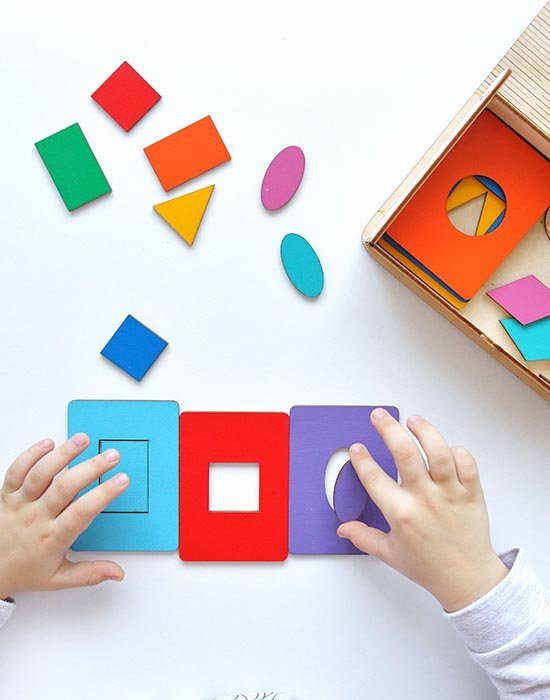
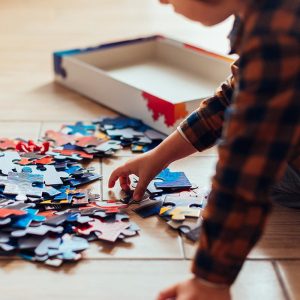
Found in the age group of 2-3 yrs. As the name suggests the child is self-centered and engrossed in its quest of exploring the environment on its own. They seem to be uninterested in the surrounding kids and activities happening.
That said, it is an incredibly important stage. The child seems to be self-reliant on its entertainment. Encouraging this behavior will not only make your life easier, but the ability to be content with their own discovery will instil self-efficacy. The extent of existence of independent play is dictated by the child’ temperament to a great extent.
Getting their play through finding through splashing in the water, or examining their new doll, or getting amused by the play of wind on their hair or flipping through a book quietly, that’s totally up to them.
Recommended toys/activities:
- Toddler-safe books: especially interactive ones having bright pictures, flaps, to fiddle around with!
- A cardboard box: the granddaddy of open-ended, limitless toys. It becomes a car, or a garage, a doll house, or a kitchen table, or used to drag around toys
- Puzzles, blocks, utensils,
If you let your child be without interfering, you’re helping them get into an independent phase. Bittersweet isn’t it!
Onlooker Play
In this stage the child observes others at play but does not engage in it. Children might imitate others from a distance or indulge in an interaction but do not show interest to join the play.
Even though this stage might seem to be inactive, it is still significant. This stage offers an opportunity to watch and learn before stepping into the action:
- Learn the norms of interacting socially and co-operatively
- Observing others do things they’re not yet quite ready for helps them gain confidence for the same
- Gaining information which will later be used within the context of their cognitive, physical, verbal, behaviours, and emotional regulation
Usually observed around ages 2.5-3.5 yrs of age. It occurs simultaneously to solitary play and is the child’s initial attempts towards group play.
Recommended toys/activities:
Show the baby what you like to do, whether it’s gardening, playing an instrument, or puzzles.
Take the baby to the local park and let them watch kids play in the sand pit or slide even if they do not want to leave you to join in. It’s the perfect enclosed area for a younger child to observe others and see how they play.
If your child has siblings, encourage them to watch the older one’s movements. While children under age 3 generally don’t understand the concept of sharing, they can still start learning how to be a playmate to your older kid later on.



Parallel Play
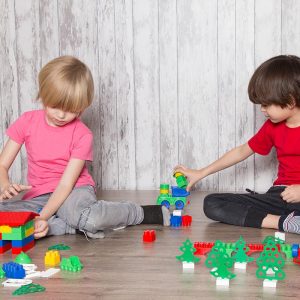
Kids happily sit next to each other but rarely interact. They may occasionally look up to see what the other one is doing or handover or ask for a toy, but majorly they spend time in their own little zone. This type of play is seen as a transitory stage from a socially immature solitary and onlooker type of play, to a more socially mature associative and cooperative type of play
Contrary to what appears that the children sitting side by side aren’t paying attention to each other, they actually are noticing the other one’s behavior, mimicking acts that seem amusing and are also willing to patiently wait until their turn.
So parents, take heart into the fact that your child is one step closer to being a social butterfly!!!
Recommended toys/activities:
This is also the stage for learning the concept “mine”. This means they are understanding boundaries. Allow them to protect what is ‘theirs’ but at the same time help them instil the concept of sharing.
- Regular visits to playground, where they need to wait to take turn for that swing
- Arrange playdates and watch them playing together yet on their own. They both want to paint, they both want the same colours, they both want to eat the same fruit and so on
- Practices sharing toys and playing together with your child to help them understand the concept and graduate to the next stage. “Let us play catch catch with the balloon. You need to throw the balloon to me for that. Playing together is so much fun”
Associative Play
You know this stage has emerged once toddlers have started sharing their playthings. It is around age 3 that their attention span is heightened and they now seek to play in the company of fellow kids. Even though there is a bent towards indulgence in play with other children but are still not exactly in tandem with each other yet. This stage differs from parallel play by the fact that the kids show interest in playing in a group, actively talking, engaging and sharing toys but they do not have a common goal yet and end up playing independent of each other.
This type of play typically begins around ages 3 or 4, extending into the pre-school age. This is an important stage of play because it develops necessary skills such as cooperation, problems solving, and language development.
Recommended toys/activities:
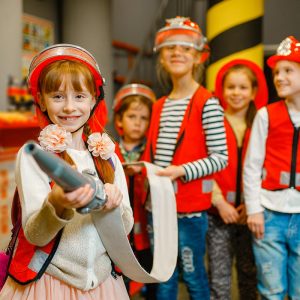
- Role plays Enacting their favorite cartoon character, or supermarket scenario
- Using the same playground toys e/g sand tools, ball etc
- Sharing a LEGO and showing each other what they can build by helping one another build.
Each child has their own focus but may be talking to each other and using the same toys to carry that out.
Co-operative Play
It is “the”stage where learnings from all the previous stages are put into practice: social maturity and advanced organizational skills. At this stage children finally come together as a team and play with a set of rules to accomplish a game. The child is interested both in the people playing and in the activity they are doing. It’s extremely liberating to watch your little ones function like mini-adults!!
Recommended toys/activities:
Encourage children to play in groups for short periods in organized activities with clearly defined rules or roles, such as sports or board games
Time for introducing: Simple board games, Hide and seek, Treasure hunt, Hopscotch


SHARE
Share on facebook
Facebook
Share on twitter
Twitter
Share on linkedin
LinkedIn
Share on whatsapp
WhatsApp
Last Chapter
Next Module