
Early Learning & Development
Areas of Learning & Development
Chapter 3.4
Share on facebook
Share on twitter
Share on linkedin
Share on whatsapp
For the child to stay curious and a self-driven learner, all areas of its learning and development needs to be supported. The Unique child draws this support from engaging with people and surroundings – Characteristics of Effective Learning
Let’s Reflect
Researchers have categorized the seven areas of learning and development into three prime and four specific areas, basis their sensitivity towards time. If a child lacks in the abilities of the prime areas s/he is 5 years old, then it becomes much harder for them to achieve later in life. Development in the specific areas is supported and nurtured by those in the prime areas.
Focusing on the prime areas enables early identification of any concerns around development (such as motor skills, speech, emotional regulation etc.). By seeking support early on, can lessening the risk of the child falling behind developmentally.
Why are the prime areas ‘prime’?
As soon as the child is born s/he constantly tries to
- connect with his/her nurtures to communicate needs and desires.
- make sense of his/her surroundings through its senses of touch, feel, smell, sight, and sound
Therefore, the Fundamental skills are formed in response to relationships & experiences and run through to support learning in all spheres.
- Personal Social Emotional Development
- Communication & Language
- Motor Development
These not only co-develop but are also interlinked making pathways upon which more complex skills develop. Let us know How?
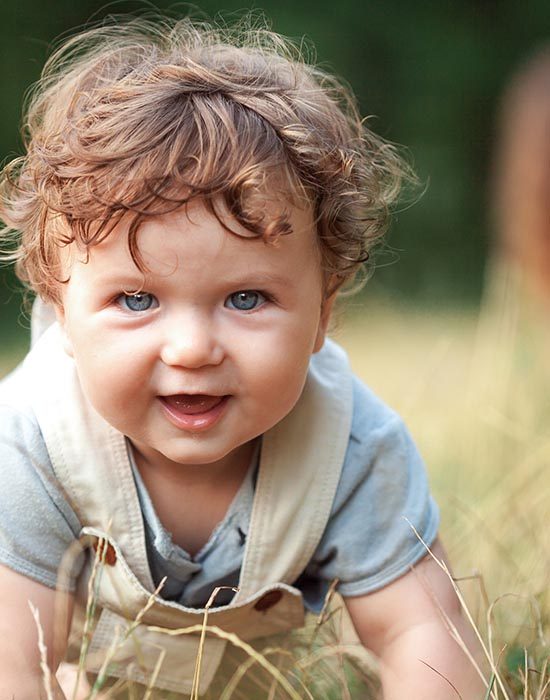
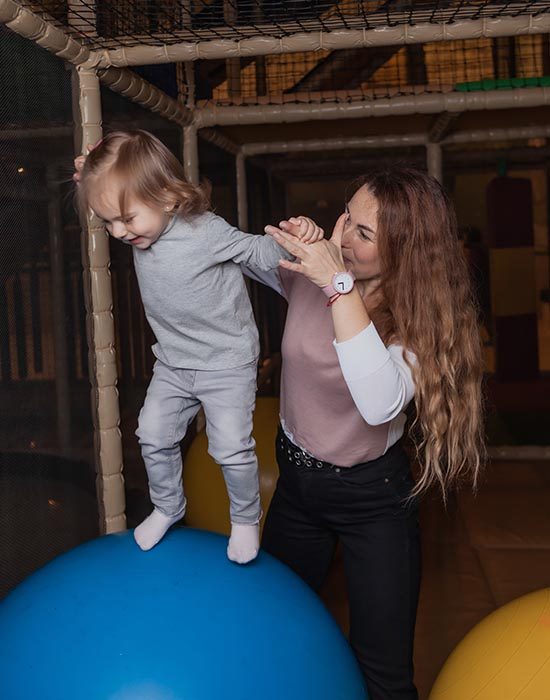

Personal, Social and Emotional Development supports:
Physical Development – Motivation to reach out and explore beyond boundaries, take risks is only possible for a child who is confident of his/her abilities, and has a well-regulated emotional balance.
Eg. Confident with his newly acquired walking skill, little Harsh tries to climb on his mother to reach to the candy jar on the side table.
Communication and Language -The desire to communicate and understand shared meanings of words is possible only when the child is aware of his/her emotional needs and is confident in expressing them.
Eg. Ritwik: Mama I want something juicy! Can I have juice?
Mom: sure sweetie! Will you get me two oranges from the fruit basket? Will squeeze out some fresh orange juice for you.
Physical Development supports:
Personal, Social and Emotional Development – Development and fine-tuning of physical grip enables a better hold while engaging with the environment thereby promoting growth in confidence and awareness of control.
Eg. 2-year-old Jennifer’s new skill or should we say achievement – ‘putting on shoes by herself’ fills her face with a sense of pride and the confidence of growing up!
Communication and Language – Being able to express through physical gestures and fine motor movements involved in verbal communication with others.
Eg. Look mama, I can… this is how the bunny hops! (does short jumps with his hands closed to his chest)
Communication and Language supports:
Personal, Social and Emotional Development – Ability to clearly articulate feelings, needs and thoughts, instils a strong sense of self and enhances the ability to relate to others in rewarding and appropriate ways.
Eg. “Mama can I want my friend Ria to come to my house, I will share my new garage set with her”
Physical Development- Describing actions (which increases conscious control) through songs, rhymes, or just words about health and the factors which impacts the way in which s/he interacts with others and access the world around them.
Eg. “Let me wash your apple before you munch on it! This will remove the dirt and germs and will not upset your tummy”
Reason for the specific areas of development being called ‘specific’?
Specific areas consist of competencies to excel socially; essential skills and knowledge necessary to thrive in the modern world.
– Literacy
– Mathematics
– Understanding the World
– Expressive Arts & Design
Thus, these are distinct areas of development dependent upon the quality of both the child’s surrounding relationships & the environment. This is therefore ought to be unique for every child and has a reflection of individual communities and cultures.
Literacy
There are two aspects
- Reading
- Writing
Literacy development involves sensitizing young children to link sounds and letters for them to initiate reading and writing. However, this exercise remains incomplete until children are supported to apply it in practical terms to reading and writing. A suggestive way is to familiarize toddlers and preschoolers with reading signs in the environment
Eg. “The red light on the traffic signal means ‘to stop’!”
Mathematics
There are two aspects
- Numbers
- Shape, Space and Measures
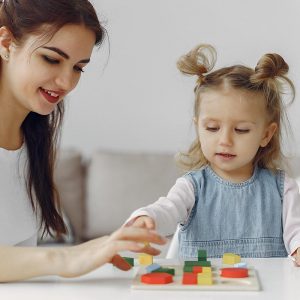
The aspect of Numbers is introduced as labels and for counting and calculating. However, mere recognition of numbers is not enough! Young children should be able to relate the acquired sense of any numerical understanding in everyday life.
Eg: “The book is under the cushion”


Understanding the World
There are three aspects
- People and Communities
- The World
- Technology
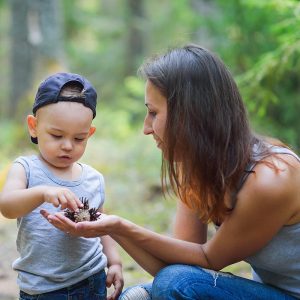
To begin with young children needs to be well-versed about the things that are important to them and relevant in their lives – immediate family, community, and cultural background. Next step is to broaden their horizon of knowledge and experience to living and non-living things. With the advent of Technology, young children engage with a variety of technological devices, often with ease, from a very young age.
Eg. “The milkman, gets milk every day for us!”
Expressive Arts and Design
There are two aspects
- Exploring and using Media and Materials
- Being Imaginative
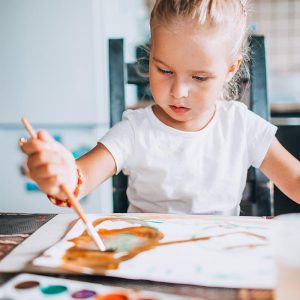
Young children are bubbling with thoughts and imaginations which they harness to explore and experiment to gain varied experiences. This is critical for their enthusiasm to keep going and in the process develop self-confidence.
Eg. “Mama look I painted this blue and it looks like a sea”
SHARE
Share on facebook
Facebook
Share on twitter
Twitter
Share on linkedin
LinkedIn
Share on whatsapp
WhatsApp
Last Chapter
Next chapter