
INFANT – Physical Development
Physical Development in Infants – Explicit
Chapter 4.9
Share on facebook
Share on twitter
Share on linkedin
Share on whatsapp
Motor development commences from head and travels downwards unto the toes;
The new-born initiates with taking control of his/her head & neck, followed by his/her trunk and eventually his/her arms and legs.
Development occurs in a stepwise, sequential manner popularly known as Developmental Milestones. It is important to note that sequence of development is the same for all babies, however, the rate of advancements and refinements is unique to every child.
Let’s Reflect
Ever wondered the life of a new-born who hasn’t started crawling yet?
Yes, babies have their own set of challenges to take care of!
Physical Challenges of a newborn:
A new-born who has just mastered the art of sitting up, is still dependent on others for bringing objects within her reach to strike an engagement.
Pivoting on her tummy is the first sign of your baby “being on the move”. Next, she will try to creep by pulling herself forward with her arms.
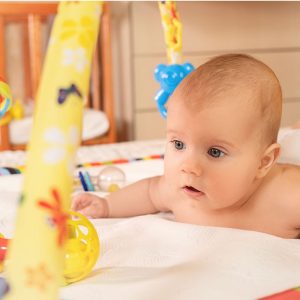
Spending lots of floor time with your baby lying on her back or stomach helps her develop coordination, balance, and muscle strength during her earliest months. And after many weeks of focused concentration and practice, your baby will be able to reach and grasp objects, support her body weight on her arms, and roll over.
Series of consistent and multiple attempts goes into each step towards coordinating movements to finally crawl. Two major lapses in the attempt to crawling are:
– Firstly, pushing up to a crawling position,
– Next trying to move his/her hands and legs at the same time.
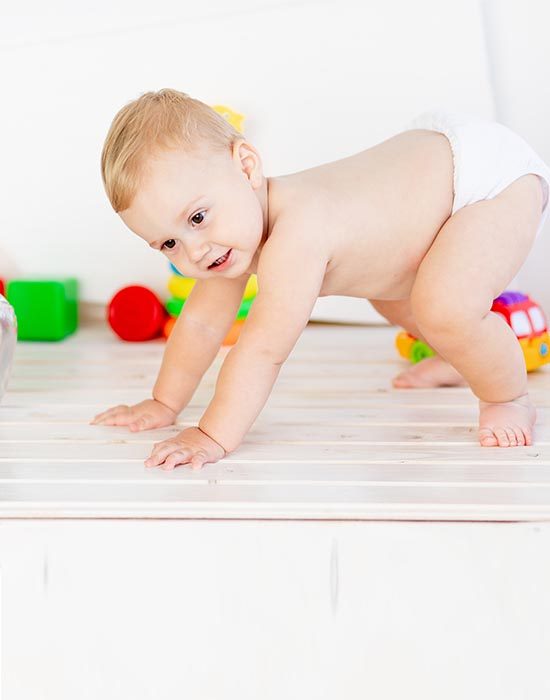



Infants Motor Development:
When the new-born etches towards actions that are more voluntary in nature:
Large Motor Skills:
The brain, the body and the environment together enable the infant towards increased strength and the ability to move from one place to another. Large muscles are primarily involved in moving two ways: up & around.
Little by little babies gain control over these muscles in the following order:
Head Movements: Turning the head from side to side and lifting the head upward strengthens shoulder muscles
Waddling: Lifting their arms and legs in the attempt to move around strengthens trunk muscles
These are the precursors to turning over and eventually sitting up!!
Fine Motor Skills:
Achievement cannot happen in isolation; areas like eyes, mouth, fingers, hands, feet. Toes, speech organs etc. To function muscles around these areas, combine and organize themselves in an increasingly refined order.
When not distracted, babies can focus on moving their hands and fingers for long time periods. This observation and interplay of hands is what prepares them for the development of muscles around their fingers and hands.
Moving on their own, enables and supports the baby’s undeterrable quest to explore other areas of development.
In Infants:
- Physical development is connected to cognitive development (thinking skills). For e.g.: Being on the move, enables Raag (7-month-old) to go on a lookout for mom, whenever she is out of sight. Gradually he has understood that mama is in the kitchen when she is away and now heads straight to the kitchen!
- Motor development is connected to emotional development: So now Raag knows where to find mom, but what if he doesn’t find her there? He persistently moves around in the house to find her. His happiness and pride (mastery motivation behavior) had no bounds on finally finding his mother in the balcony. Challenging tasks, drives the motivation to engage and improve further.
- Building up of fine-motor skills: Being mobile enables the baby to grasp objects while on his/her self-tour around the house. Thus, those tiny finger muscles are being prepared for advanced handling skill.
- Developing social Skills: Once locomotive, the baby is no longer dependent on others and can make choices in his/her explorations and move toward an object that draws his/her attention. S/he can also communicate by moving towards things she wants or needs.
Fostering Motor Development in Infants:
- Do not Push it:
Let them repeat what they know over and over again, to their heart’s content. This is how they get ready for their next stage. Pushing them to get into the next stage keeps them from exploring and mastering their foundational skills. - Avoid Teaching:
The process of attaining a position is what matters and not just being in the position with your help. The act of trying is what facilitates development. Infants learn to stand by strengthening their muscles during learning to sit and crawl and not because you held their hands to walk them. - Optimum Stress:
A certain level of stress stimulates growth, instils motivation, and strengthens both the mind and the body. So next time you see your child not able to crawl over a cushion, hold yourself from rushing to help. Let him/her strive until they succeed. Just keep a close watch to avoid any harm.


Encouraging Healthy Development
Incredible growth occurs during the first three years of a child’s life. There are many things you can do to support and nurture your little one’s healthy development during this time. Below, listed are some specific activities to encourage movement (Physical or Motor Development) during the first year of birth.
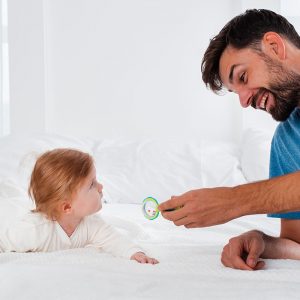
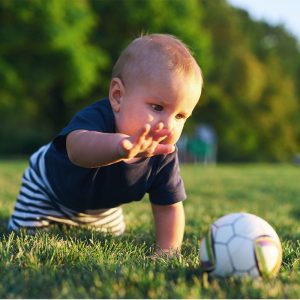
Place things nearby and offer opportunities and chances for infants to reach for things. You could offer teething rings, carrots, soup sticks, , rattles, and other things for them to reach out and grab
– Put your baby on his/her tummy or back and put toys just a little out of reach to encourage rolling and reaching.
Provide many opportunities to practice and use new skills, such as sitting up on your lap as you support your infant’s neck and back (between 4 and 6 months).
– Help your baby to sit or support with pillows; let your baby look around or give toys to look at while balancing.
– Place your baby on his/her back to sleep during naps and at night.
– Introduce liquids in a cup.
– Spend time playing on the floor with your baby every day:
– Ensure your infant sees your face when you talk and play with him/her. Create, safe areas for your baby to crawl around and explore.
– Stay close by as your baby explores and moves around so he/she knows that you are near.
– Put your baby close to furniture to safely use it to pull up to stand.
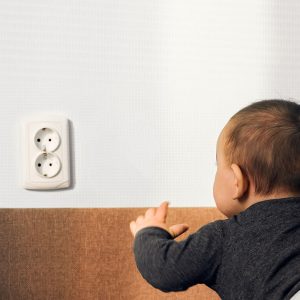
– Child-proof your home as your baby begins to move about: lock up household cleaning, laundry, and other care products; use safety gates; and lock doors to outside, basement, balconies, windows, staircase etc…
– Hold onto the infant’s feet and rotate them gently as you sing songs like “The Wheels on the Bus.”
By now your baby’s back muscles have strengthened enough for her to have stability while sitting. Looking at the world from the vertical point of view. Soon her instinct to reach out for nearby objects, will be supported by her physical ability to shift her weight, reach across her body and grasp an object. In no-time you will find her pushing herself forward onto her hands and knees!
SHARE
Share on facebook
Facebook
Share on twitter
Twitter
Share on linkedin
LinkedIn
Share on whatsapp
WhatsApp
Last Chapter
Next chapter