
INFANT – Literacy
Early Literacy during Infancy
Chapter 4.12
Share on facebook
Share on twitter
Share on linkedin
Share on whatsapp
4-month-old Mehul, is enjoying a non-verbal communication by looking into his mother’s eyes. It is a special moment. The mother lovingly sings a rhyme to him, and is thrilled to see the pleasure on Mehul’s face. Mehul is an equal partner in the ‘conversation’ and is encouraging his mother to keep on communicating: the way he opens his mouth in rhythm with his mother’s speech, as if he is about to speak!
Therefore, to give your baby the best possible start to ‘literacy’ treat him/her as interested and interesting communicator. The idea is to strike meaningful conversation, ones that have a sense of direction or intention.
Let’s Reflect
Infants learn literacy skills much the same way they learn language skills.
This means the rapid brain growth that is going on to facilitate language is also setting the stage for literacy. The attachment relationships that are being established, the perceptual-motor experiences that are being organized, and the cognitive events that are being processed all contribute to emerging literacy during infancy & toddlerhood.
Emergent Literacy is interrelated, holistic and ongoing.
Early literacy is different from reading readiness, which is about introducing shapes, colours and the use of writing tools.
Emergent Literacy is a process of developing awareness about oral (language & reading) and written language, and it starts at birth.
Infants hear lots of spoken language (rhymes, songs, rich intonations and of course daily conversations) around them and they too participate by means of uttering sounds. They keenly observe facial expressions of people around, and the details of objects that catches their attention. This progress to use of words as a toddler. If the child is growing up in an environment with varied print material around to interact with, he would gradually realize that those words can be written down and read back to them.


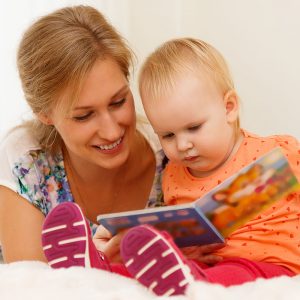
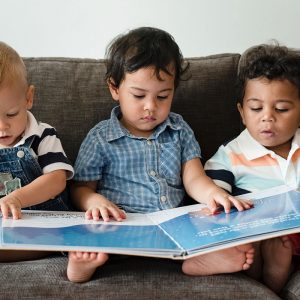
It’s never too early to start reading to your baby
Cuddles and stories – Good feelings about language, stories and books can last a lifetime. Ensure that your baby associates books and storytelling with love, security, closeness and pleasure. They will gradually enjoy a special story language that has very satisfying rhythms and repetitions
Pictures – Looking at the pictures in books and talking about them helps your baby make sense of what is going on in a book. Closely looking at pictures also develops the useful literacy habit of concentrating on tiny details. As they grow into and start to become readers, they begin to look at words, letters and notice changes in groups of letters.
Voice Modulation – As you talk about the pictures in a book, incorporate tonal variations such as: delighted tones, puzzled tones, exclaiming tones, curious and wondering tones. This helps:
– to hold the attention of your infant
– him/her make tone-image relations
thereby, making your baby’s experience with books so pleasurable and so interesting.
Black marks- Picture Books are for beginners to set foot into the literacy world by observing and exploring written language. These tell them written language and illustrations are means to communicate. Besides story books, showing other books, magazines and other print, will help him/her understand that the ‘black marks’ are also telling a story. Touch and feel books are made for these tiny bubs to stimulate their senses with textures, colours and associate with their world.
Tip: Touch and feel books are made for these tiny bubs to stimulate their senses with textures, colours and associate with their world.
Enjoying cuddles, stories, pictures & print with parents helps babies to get the message that literacy is about communication and pleasure. So, cuddle your baby on your lap, and introduce him/her to the enchanting world of stories and printed characters in the most intriguing ways.
SHARE
Share on facebook
Facebook
Share on twitter
Twitter
Share on linkedin
LinkedIn
Share on whatsapp
WhatsApp
Last Chapter
Next chapter