
INFANT – Math
Math for Infants
Chapter 4.14
Share on facebook
Share on twitter
Share on linkedin
Share on whatsapp
Harsh is feeding Meher, his 9-month-old daughter, her favorite apple sauce. As he kept the bowl to go get a napkin, he could hear a soft “more more!” In the background! Harsh affectionately said. “Oh, you want more? Here you go.” Once the bowl is empty, Harsh points towards it and says “finished”. ” Meher has finished her applesauce!” Meher looks at him and smiles…
Let’s Reflect
From the moment they are born, babies begin to form ideas about math through every day experiences. Mindful parental interaction helps the baby to develop math concepts & skills early on in life.
Why Promote Mathematical Experiences in Infants?
- Infants are born with the innate ability for logico-mathematical thinking. Parents need to strategically connect their child’s implicit and intuitive experiences to the explicit and guided learnings. They are busy from birth using these capacities to construct and understand the world around them.
- Accumulated evidence from cognitive research shows that in the first 3 years of life children develop foundational mathematics like big, small, square, circle, more less and so on through informal and spontaneous everyday experiences.
- Children’s math concepts at school entry are the strongest predictor of later overall school achievement. Deep and meaningful engagement with concepts must come before a child is ready to absorb the early mathematics in preschool.
Hence, it is important that parents make conscious effort towards creating a rich mathematical environment for their infants
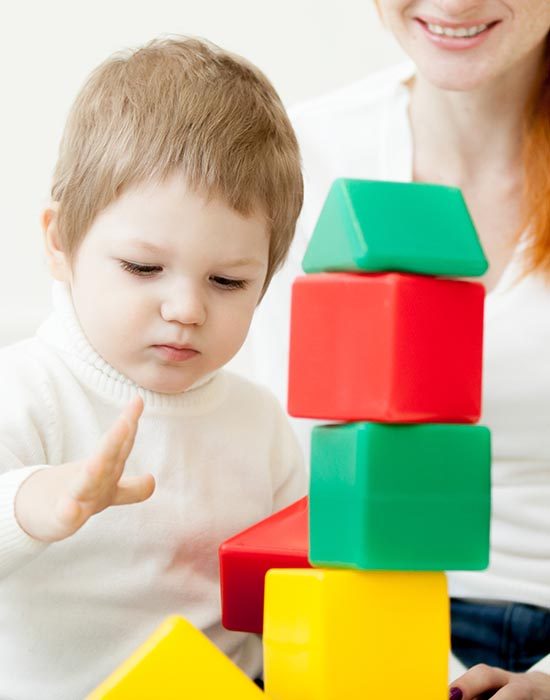
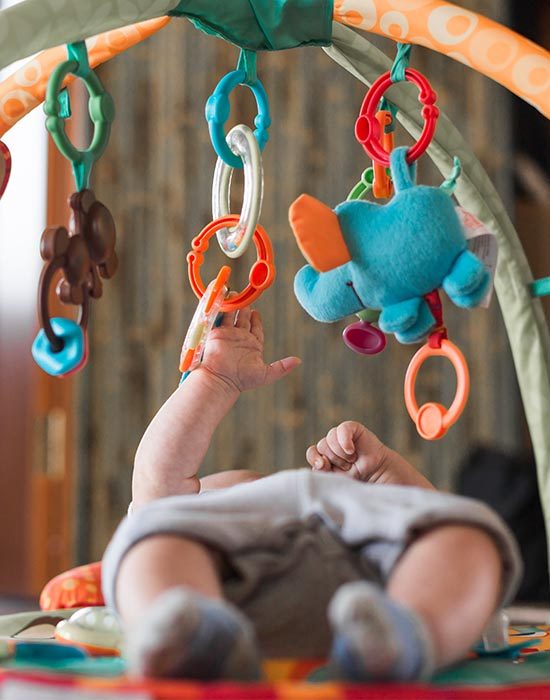



How high functioning can an Infant brain be?
While they may look helpless, newborns arrive hard-wired to perceive quantity and magnitude as well as spatial relationships, regularity, and sequence.
The emerging (birth to 14 months) stage (Implicit)
Following are the early math concepts of developmental trajectories for Infants:
- Sensing Attributes:
The five senses of the baby, enables him/her to perceive the properties of qualities of the elements around. Although infants cannot explicitly know or describe the attributes of their encounters, these characteristics help them classify and, in the process, make sense of the world around. Infants see everything as falling largely into two large categories:
– What they like because it makes them feel comfortable and safe or
– What they dislike because it makes them feel uncomfortable and unsafe.
Eg: The breast milk is warm and comforting; the loud sound of the whistle makes the infant uneasy.
- Notice & Compare:
Matching, sorting, ordering and problem-solving is their natural way to notice the sameness and differences amongst various attributes.
Eg: All the red balloons are on the floor and all the blue balloons are in the basket;
My nappies are kept on the cabinet and my clothes are inside the cabinet.
- Pattern Prediction:
A recurring set of Rhythm, Sequence and Regularity defines the elements in a pattern. With the regularity in sequence there is an expectation in the pattern, which a baby gradually gets a hang of.
Eg: Clap on “hurray” in the rhyme;
My blanket has stripes: pink, white, pink, white, pink, white
- Change:
Qualitative or quantitative differences may occur owing to joining, separating, or of transforming of substances. The ability to recognize the difference between the initial condition and the changed condition allows young children to respond to change.
Eg: Stranger Anxiety is one of the foremost displays of identifying parents from strangers;
It is dark outside now, time for daddy to be home.
Even though the concepts are present at birth, they will not automatically mature into scientifically sound mathematical knowledge and understanding without adequate support from adults (NRC, 2009)
The CAIR approach
Closely Attending and Intentionally Responding—to nurture the development of mathematical concepts.
While closely attending will help you know your child’s needs, intentional responding calls for positive interactive communication using gaze, touch, gestures, body language, and vocalizations to acknowledge and meeting your child’s needs and wants
Eg:
Infant: Before crawling away, turns back and looks at his dad, as if asking for his consent.
Dad: Smilingly says ‘go ahead’
Infant: Hurriedly crawls for an escapade.
Infants use social referencing to
- Seek out and use information in the facial (but also vocal or gestural) emotional expressions of others to guide their responding in contexts of uncertainty or ambiguity (Campos & Stenberg, 1981; Sorce, Emde, Campos, & Klinnert, 1985).
- Characterize their perception and use of other persons’ interpretations of a situation to form their own understanding of that situation (Feinman, 1982; Feinman & Lewis, 1983).
Majority of math activities for infants should revolve around interactive talking. Making a conscious effort to include basic math in everyday conversations with your infant can help him/her shape developmental trajectories that lead toward higher levels of success in their forthcoming years.

SHARE
Share on facebook
Facebook
Share on twitter
Twitter
Share on linkedin
LinkedIn
Share on whatsapp
WhatsApp
Last Chapter
Next chapter