
INFANT – Math
Math Talk Ideas with Infants!
Chapter 4.15
Share on facebook
Share on twitter
Share on linkedin
Share on whatsapp
It is all about including basic math in your everyday interactions with your infant. Shapes, patterns, colours, numeracy is all around us, its just a matter of making a conscious effort towards making your infant familiar with them.
Let’s Reflect
Bringing more math into the home doesn’t have to take up any extra time:
Parents can talk about math with their new-borns while reading books, having meals, playing with toys, and even just going about their regular routines.
Early Math Concepts – Where to begin:
– Identification of Shapes :
Round clock, the triangle print on the bedsheet
– The concept of More:
Oh! You want more grapes!
– The concept of Zero:
Oops! there are no bananas left in the fruit basket
– Sequencing:
Let’s take a bath first and then head out to play.
– Sorting & Classifying:
Helps the baby make sense of the world – Will you help me separate the vegetable from the fruits?
– Spatial Relationships:
Help your baby relate physical relationships between objects – You are crawled under the table!
– Identifying patterns:
Match the pair of socks based on pattern (stripes, colour, design etc)
– Measurement:
Talk about size, distance, time



Some everyday ways to strike a math conversation with Infants:
Read Picture Books:
Not sure how to talk about math with your baby?
Well, picture books that involve counting or shapes can be a great starting point. These books might also help parents think about how they can talk about the same ideas during other activities.
You could begin with what is provided in the text, and then extend the text to relate the math contexts to your baby’s experiences.
Eg: When reading The Three Little Pigs, prompt your baby to show their three fingers or to find three other books they want to read.
Incorporate Math Talk into Play.
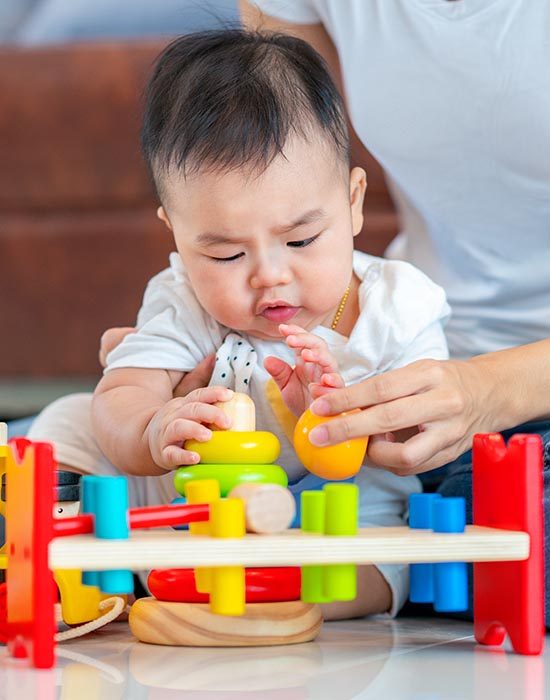
A simple playing with blocks, can offer many opportunities to talk about math. Eg:
– Count how many blocks are stacked together, compare shapes and sizes of blocks, and make patterns by alternating colors of blocks.
– At the playground, you talk about space as your baby moves around: “Here we go up the ladder, and down the slide. Let’s go in and out of the tunnel.”
Talk About the Math in Everyday Activities. Talk math while going about regular routines. Eg:
– I’m measuring three scoops of oatmeal for our breakfast—one, two, three.
– One banana for you and one banana for me.
– Do you want more?
– Let’s separate the big clothes from smaller ones.
What should parents do?
To spark interest about math, is in fact much more important than learning a particular ‘math concept’ at a particular age. Remember that math is a process and your child will get there. Always:
- Model a positive attitude toward math. This sends the message to your baby that math is important and can be fun.
- Process Praise your baby’s effort, focusing on what s/he is doing (“ I can see your are trying hard to reach out to your square shaped rattle!” or “You gave me exactly two things. Good job!”), rather than providing person praise, or praising your child’s inherent abilities (“You are so smart!” or “You are born genius!”).
- Start early: Think of it as getting yourselves into the habit of supporting your child’s math development!
For eventually, all children face hard problems—including hard math problems. If they hear a lot of person praise, they may decide that their inability to do the hard problem reflects a lack of ability. In contrast, if they hear a lot of process praise, they are likely to decide that, with effort, they can solve the problem (Kamins & Dweck, 1999; Mueller & Dweck, 1998).
No one knows at exactly what age babies start to benefit from parents’ talk about number and space. However, the fact that, babies are always listening and watching and thereby subconsciously absorbing parental talks and actions, means they are also picking up learning from all the math talking happening from you!


SHARE
Share on facebook
Facebook
Share on twitter
Twitter
Share on linkedin
LinkedIn
Share on whatsapp
WhatsApp
Last Chapter
Next module