
Toddlers - Communication & Language
What Language Allows a Toddler to Do: The Cognitive Link
Chapter 5.10
Share on facebook
Share on twitter
Share on linkedin
Share on whatsapp
Toshi joyfully points to her grandmother, the pigeon who has come to perch on the balcony rail and then flies away in a minute or so.
The experience of seeing a pigeon and learning that label, gradually moves into a child’s understanding that this grey flying creature is called a pigeon and that this creature has wings to fly and a beak instead of mouth. Toshi has also understood that it is a kind of bird, thereby is also able to relate it to the larger category of “birds.”
Information can be generalized from this understanding, but it all began with the label “pigeon.”
Let's Reflect
Apart from communication, language has a significant impact on ‘thought, cognition, and self-regulation’.
Talking about experiences does not necessarily have to be about the “present” scenario. Experiences can be recalled, and talks can happen by labelling a word against an object. With time the memory bank of the child grows, having all these labelled experiences.
This memory bank will soon have categories within it. And the categories will eventually allow for a complex classification system.
Watch (and listen) to a toddler as s/he plays.
You may often overhear her actually telling herself what to do (“I’m going to get my toolbox. Then I am going to fix my peppa car”).
In the above example the verbal instructions to self allows the child to gather and plan (cognition) her ideas (thoughts) and behaviour (self-regulation) and then accordingly put them into action.
Language thereby enables the following:
1. Be more clearly understood by others
Eg: “I want bread and jam. I will spread the jam myself 1 Please Mumma”
2. More tangibly understands events around.
Eg: “The clouds are bursting, and it is dark outside. It is going to rain mama”
3. Increases adaptation and coping skills.
Eg: “My tummy is hurting. I will eat my chocolate later”. And keeps his chocolate in the fridge.
4. Picks up non-verbal communication.
Eg: Dad: Smriti did you see Vinay covering his face when you threw the ball at him. It is because he was afraid that he might get hurt. Let’s be gentler at throwing. Come let me show you.
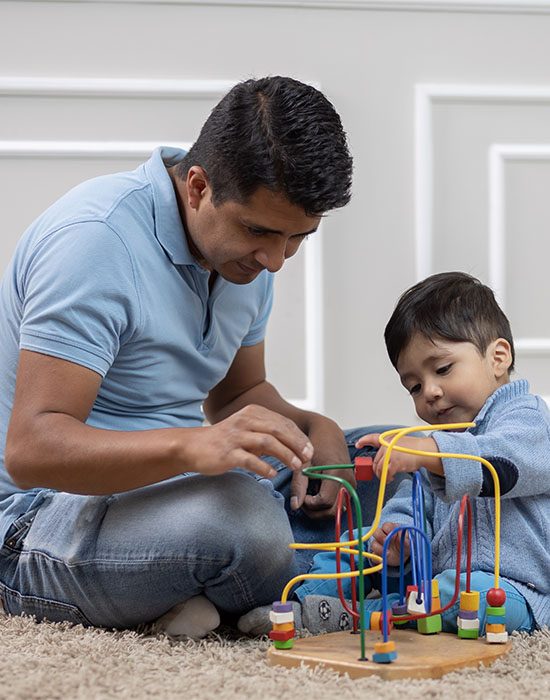
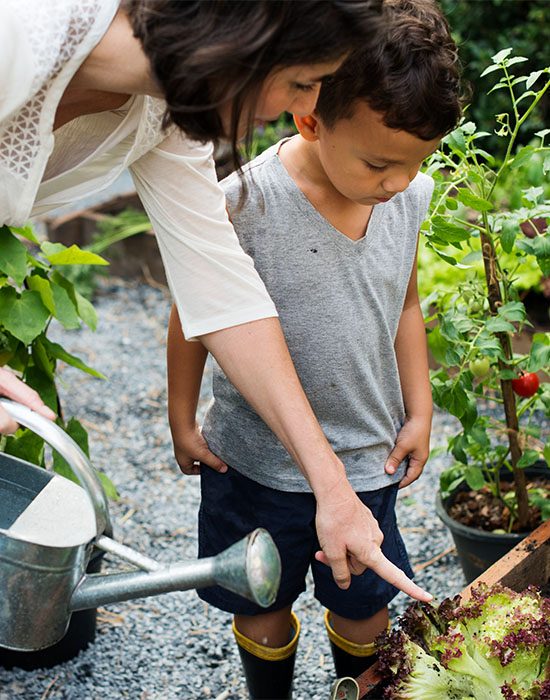



Let’s face it, those young brains are working so hard during these first few years!
Children in their early years are deep in the process of learning and brain development. Beginning of the first year marks the beginning of true imitation, or imitation with intent.
How? Mostly by Imitating their ‘parents’!
Imitation is a gradual process, which initiates right after birth. Very young children spend a lot of time observing and processing information before they attempt something. Therefore, parents play a vital role by naturally modelling the communication and language development process!
Imitation by your mini-adults follows a four-step process:
- Watching and - listening to ma, pa, da sounds and imitates the same as a new-born
- Processing the information – Toddlers begin to narrow down the sounds to ones that make sense, like dada for Daddy.
- Attempting to copy a behaviour or word – Then they finally use dad or dada or papa or Daddy for his/her father
- Practicing and more practising - until s/he can use the word in the right context.
Why? Imitation for toddlers is much more than a show!
It is vital to the development of a vast array of abilities ranging from language to social skills. Toddlers are aware of the fact that the actions s/he is copying has a significance!
Imitation is an attempt by the child to:
- Bond with his/her parents
- Likes and gets encouraged by the attention s/he receives.
- Discovers control of his/her actions. On imitation toddlers realize their potential: Wow! I can also do this! I am big too! Let me try it again, “This makes them act out of self-motivation
What? Toddlers are in constant mode of forming impressions of their own!
They usually pick up words or actions that they wouldn’t fully comprehend yet.
Eg:
Toddler: Looks keenly at his new stuffed toy
Dad: It is such a loooonggg caterpillar isn’t it? And it has so many colours. It is a ‘colourful’ caterpillar.
Toddler: He wore a t-shirt having stirpes in multiple colours. Look dad I am wearing a ‘colourful’ t-shirt!
Communication and Language development is also a stepping-stone to Independence! So Dear Parents pull up your socks and be at your best behaviour as your child will be your shadow!
SHARE
Share on facebook
Facebook
Share on twitter
Twitter
Share on linkedin
LinkedIn
Share on whatsapp
WhatsApp
Last Chapter
Next chapter