
Kindergartner – Literacy
Early Literacy for Kindergarteners
Chapter 7.10
Share on facebook
Share on twitter
Share on linkedin
Share on whatsapp
Dad: K for Kite, Kangaroo…
Child: Dad, K for Karnataka (picked up from his India Map puzzle), and also kitten. She is so cute. I want it. I will feed her milk.
Let’s Reflect
The major finding of a study is that students who learned to read in kindergarten were found to be superior in reading skills and all other educational indicators as measured as seniors in high school.
Other research also confirms that children’s language and literacy skills in preschool and in kindergarten are strongly related to later academic success. And ofcourse the children’s vocabulary levels and background knowledge have a significant impact on their writing.
What is Early Literacy?
Early literacy also known as emergent literacy is about familiarizing the child with the concept of reading and writing before the child can actually read and write. Hence, it is advisable to introduce early literacy right from birth.



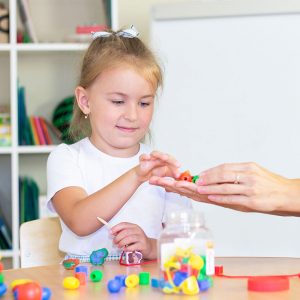
Literacy up to Kindergarten Years is all about:
Development of both a rich vocabulary and a deep understanding of many concepts and language structures. Developing reasoning, creative and critical thinking, and inquiry skills.
- Being aware that written language is a system for representing oral language.
- Literacy is listening to sounds, intonations, phrases and sentences. It is the development of oral language to communicate to others.
- Literacy is the development of fine motor skills so that they can be strengthened to be able to hold a pencil that will eventually produce the written word.
- Learning concepts about print (what is a letter, what is a word, directionality) and concepts about books (the purpose of a book, book features).
- Understanding that speech can be segmented into small units of sound and learn how to play with language (phonological awareness) by rhyming, segmenting, and blending
- Recognizing alphabets and their corresponding sounds.
- Gaining ability to print most letters (when provided with letter names, sounds, pictures, or key words) and a few words (using invented spelling and a few for-sure words, such as their names and other familiar and high-frequency words).
Traits of Early Literacy – When the child:
- Begins to willingly and independently engage with books.
- Enjoys being read to and sees a purpose for reading and wants to read.
- Is able to listen to and understand stories and informational books. Is able to retell stories in parts and pieces but includes important information.
- Sees a purpose for writing and wants to write.
- Recognizes his/her own name in print in addition to a few other familiar and high-frequency words such as box, eyes, ball, bat etc…
Predictors of future literacy success that lasts well into high school
1. Knowledge of Letters:
Letter recognition must become automatic. Let us find out how:
- Knowing the names of printed letters: It is not just accuracy, but also the ease and fluency with which children can name letters that gives them an advantage in learning to read [and write]. Recognising letters with confidence, will aid in seamless yet thorough grasping of letter sounds and word spellings.
- Knowing the sounds associated with printed letters: Each letter name contains a sound typically represented by respective letters. For example, recognizing a ‘b’ will help the child to remember that its sound is /b/. The more time the child spends on figuring out letters, the less time and energy s/he will require to decode print and to write.
2. Discrimination between Individual sounds (Phonemes)
It involves
- an understanding that spoken language is composed of a series of individual sounds, and
- the ability to play with these sounds. breaking words apart into smaller sound units such as syllables or phonemes, adding or deleting sound units:
– Understanding that the word bulldozer is made up of 3 syllables, ‘ba’, ‘na’, and ‘na’
– Or, knowing that If you add the sound /c/ to the word ‘lock’, you get the word ‘clock’
3. Oral language proficiency (Receptive and Expressive):
This includes vocabulary knowledge. However, along with the strong foundation in oral language, the need of a strong understanding of both the concept about books and about print is indispensable.
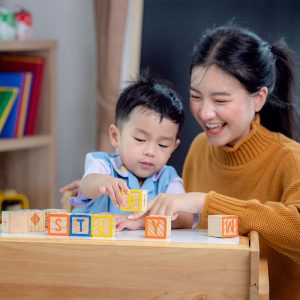
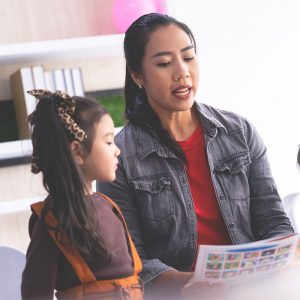
Early literacy begins at home and is significant in helping children to be able to communicate with their family, their peers and the wider community. Building blocks for language, reading and writing development, can all happen during play and daily living in the early years in a child’s life.

SHARE
Share on facebook
Facebook
Share on twitter
Twitter
Share on linkedin
LinkedIn
Share on whatsapp
WhatsApp
Last Chapter
Next chapter