
INFANT – Communication & Language
Building Communication & Language Skills from Birth
Chapter 4.11
Share on facebook
Share on twitter
Share on linkedin
Share on whatsapp
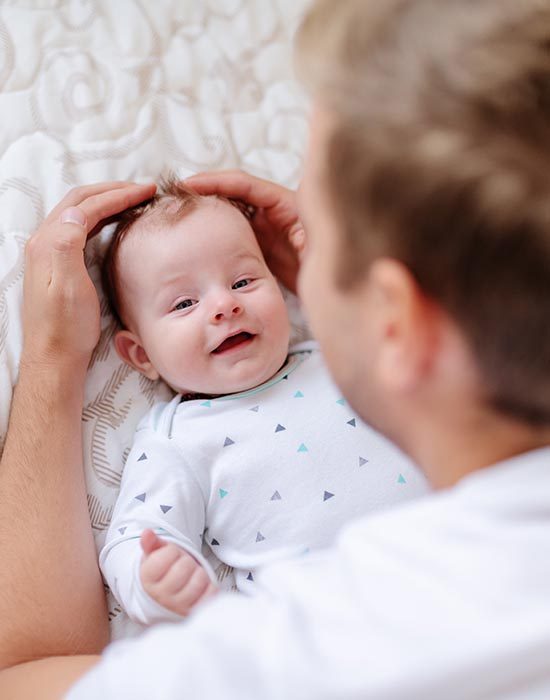
The 6-month old Namay’s eyes keep following her mother in the room. Just as his mother makes eye contact with him, he starts squealing with joy. The fact that he was able to connect with his beloved mother both verbally and non-verbally (eye-contact) gave the little one immense security and a sense of belongingness.
The capacity to communicate is an indispensable means to survive. To get a need met or to establish and maintain interaction with a loved one, this desire to communicate begins right from birth!
Let’s Reflect
In the first months of life babies express by using other languages, such as crying, smiling, movements of throwing their arms and body towards the adult and the objects they want, closing their hands as if they wanted to grab something they cannot reach, etc
So, indulge in Serve & Return Interactions at every opportunity you get. It is never too late to have back and forth conversations with your baby.
Parent–infant ‘interaction’ is a key factor towards fostering communication & language development in infants.
It is not just about “quantity of words” the infant hears. Vocabulary Enrichment is also a function of the “quality of Interaction” with parents and other adults around.
Some of the suggestive ways are:


Babies prefer Parentese
Slowing down your speech, speaking in a higher pitch and giving pauses for them to respond. Infants are responsive to language from the very first day of life. The rhythm of their body movements will correspond to the rhythm of early language conversations.
Strike meaningful communication like:
“Ohhhh! you are pointing to the parrot in the picture.” Or “You are yaaawwwning. Let’s tuck into your favourite PINK blanket and take some resttttt.”
Give Immediate and Sensitive Responses
Responding back assures you baby s/he is important to you and will motivate the infant to communicate further.
Whereas, attaching words to their actions will be instrumental in building your child’s vocabulary.
E.g.: If the baby triumphantly throws out hands and legs as soon as s/he sees you, say “Oh you want me to pick you!!” OR coo as and when the baby coos.
Ensure your little one’s participation
Engagement begins as early as 3 months of age. It is important for the parent to pause and look expectantly at your infant. This will let your baby know that it is his/her turn to “speak” and teaches her about the back-and-forth of communication.
Babies usually responds by kicking his/her legs and arms or through smiles, babbles and coos.
Narrate as to what is happening…
As per research, it is one of the best ways for young children to learn language and communication. Consistently describe actions and/or label objects as and when you carry out your daily routines with the infant.
– Let’s put this pretty bow in your hair.
– It is cold outside, so let’s put on a cap, to keep you warm
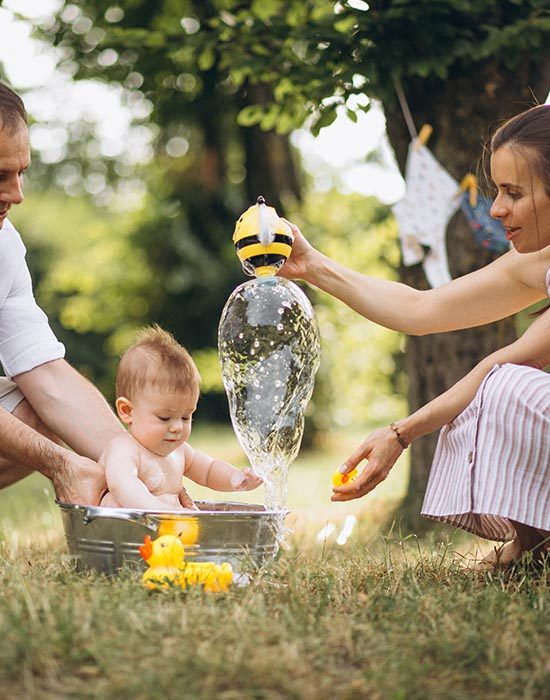
– It is bath time now! Are you ready with your peppa and friends?
– You seem to be still hungry. Let me get you some more mashed potatoes.
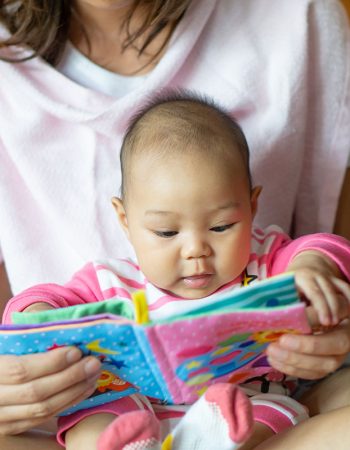
Read: Reading inoculates strong language skills. Encourage your infant to touch pictures, turn pages. Point at pictures and describe them. Ask questions as to why you think the cat was happy? What was the naughty rabbit upto? What would you rather have a feather or a bushy tail?
So, parents buckle up and be at your best behaviour. Ensure a loving, warm environment and use simple, enjoyable interactions and play to encourage your baby’s communications and language skills.
SHARE
Share on facebook
Facebook
Share on twitter
Twitter
Share on linkedin
LinkedIn
Share on whatsapp
WhatsApp
Last Chapter
Next chapter