
INFANT – Communication & Language
Communication & Language with Infants
Chapter 4.10
Share on facebook
Share on twitter
Share on linkedin
Share on whatsapp
A 10-month-old starts messing with the food on her plate, as if wiping it clean with her hands. His father notices, saying: “Hey sweetheart, looks like you’re telling me you are all done. How about I keep the plate for you and we can head to play.” This baby is learning that she is an effective communicator.
Let’s Reflect
Parents become the mediator of the first sensorial contacts of the baby with the world around him or her. Rich experiences of the baby with his/her parents ensures enrichment of visual and hearing impressions. This in turn, contributes to the organic evolution of the senses in a satisfactory manner.
The simultaneous development of the 3Is lead to the emergence of language:
- Innate abilities i.e. having certain cognitive skills and mental structures to develop language.
- Opportunities to Interact with others in a range of situations – develops the baby’s confidence and skills in self-expression.
- Interactions should be responsive, for the baby to imitate them.
Communication & language is one of the three prime areas in the Early Years Foundation Stage
Social relations wiggle its way into the baby’s life right after birth. Tending parents become the centre of attention of the baby. Constant talk, affection, attention generates the need for new impressions (Bozhovich, 1981), i.e. the need:
to see more, to hear more, to touch more and to be touched more.
Infants all over the world begin to develop language in very similar ways. There are two developmental levels of language:
Receptive (birth to one year) and Expressive (end of first year to beginning first words)—gives more insight into the progression of language.

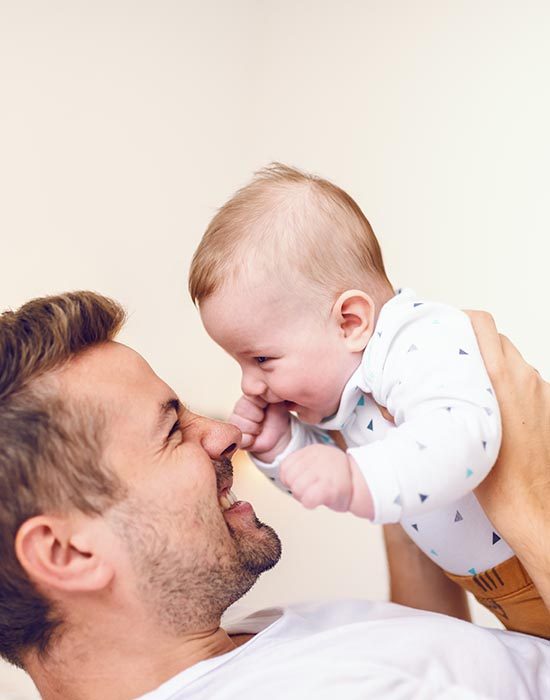

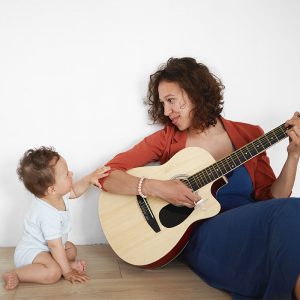
Receptive Language: The Importance of Responsiveness
In the first months of life, babies are not able to express themselves through conventional talk yet. However, they can communicate with the people around through sounds and actions (such as crying, smiling, movements of throwing their arms and body towards the adult and the objects they want, closing their hands as if they wanted to grab something they cannot reach, etc)
As the baby gets familiar to the rhythms, pitches and sounds of words being spoken to, language becomes instrumental to soothing or exciting them.
– Grandpa greets with a lingering “Good Morning” tone every day!
– As the phone rings, mama picks up and says “hello”
– Story books with the same sounds has same pictures
Unlike walking, learning language is not a naturally happening product of maturation
The infant might have the ability to talk, but in the absence of a responsive environment could lead to a language delay.
Initiation sets in once the new-borns respond to voice, pitch, tone they are spoken to or hear in the surroundings. Mind you, all this is happening without the baby actually comprehending their meaning.
In a language rich environment, the baby gradually initiates processing connections between sounds, sound patterns and objects or happenings. Eventually the babies begin to respond to the meaning behind the words, better known as receptive language.
Expressive Language: The Importance of Familiar Contexts
Cries mark the beginning of vocalization! Eventually the baby gains skills to convey clear cut feelings of hunger, laughter, discomfort, pleasure and more. This graduation towards usage of words depends a great deal on the:
- Responsiveness of the parents: Responding (through expression, words, sounds, gestures) signals the baby that s/he is being tended to. This encourages them to continue expressing and honing their communication skills
- Opportunity to hear the labels of familiar objects: Acquiring of first words along with their meaning begins towards the end of first year of birth. Consistent repetition of labelling objects creates lasting impressions and thereby leading to faster vocabulary development.
Repeating sounds and learning language need to be embedded in meaningful, everyday experiences.
Constant Corrections are a Big No! By repeating everything the baby tries to say in a more correct form does not add to the baby’s content. These merry-go-round conversations are meaningless. In fact, it might discourage the baby from trying to speak out.
On the other hand, repetition of sound patterns (ma, da, ba etc) leads to formation of “auditory maps.” This ability is at its peak during the first 12 months of the baby.
Everyday stimulation of sounds/words with responsive parents leads to strengthening of neural pathways in the brain circuitry.
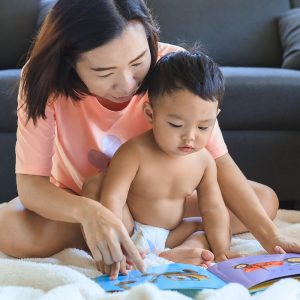

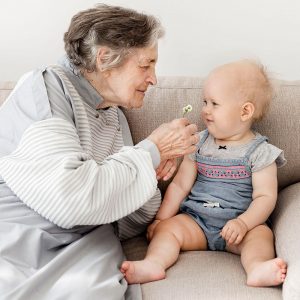

Let’s look at a parent-child interactive session with a farm animal picture book:
- Describing-Commenting: Conversing with the baby in details, helps in better retention of the language
Eg:, the parent says, “This red flower is called rose, doesn’t it smell lovely? “or “This Yellow Mango is so juicy! Isn’t it?”
- Pointing-Labelling ensures robust language development. It is to be done in a manner that your infant is able to comprehend what is being pointed out or labelled.
Eg: the parent says, “Look, these are called trees!” or “These are my clothes.”
- Inquiring-Clarifying is effective in enhancing language development. Remarkable improvement in the infant’s comprehension occurs when parents follow their child’s lead rather than challenge his/her limits.
Eg: Parents saying:
– “Is this your toy in the picture kust like yours?” and answering “Oh yes, it is!”
– “Look, you have the same dino as in this book!”
– “What does the cow say?” and then answering: “the cow says moo”
- Expanding-Elaborating
Eg:
– When the child visits a grocery shop with mom and points to the fruit, the parent says, “Yes, this is a pear. You ate it as your mid-day snack!” or
– The child points to a ball in the park and the parent says: “I think this ball looks just like the one we saw at the toyshop!”
- Repeating-Imitating: The parent repeats what the child says, is linked to the child’s subsequent ability to link words. Infants begin by picking up the pitch and contour pattern of parental lingual, way before they understand individual words. Babies deliberately imitate facial expressions as well as the sounds, intonations and volume of what they hear. The aim is to evoke a reply during playful interactions with your baby.
Eg:
Baby: gazes at the elephant rattle, and intently hears the sound it makes!
Mother: Noticing the child’s gaze asks: The elephant is adorable! Isn’t it!
Baby coos and laughs and continues watching the rattle play
Mother: Yes, you like it too.
During the first year of early childhood, eye gaze, expression of emotions, and making attempts for the attention of others, are the earliest aspects of infant communicative capacities. The earliest parent-infant “talks” introduces your little ones to the world of voices, sounds and words thereby making the little one familiar to the ways of communication.
SHARE
Share on facebook
Facebook
Share on twitter
Twitter
Share on linkedin
LinkedIn
Share on whatsapp
WhatsApp
Last Chapter
Next chapter