
Preschoolers – Communication & Language
Communication & Language with Preschoolers
Chapter 6.9
Share on facebook
Share on twitter
Share on linkedin
Share on whatsapp
Shruti’s Show and tell at playschool:
“This is the map of India
I live in Uttar Pradesh.
My dadi’s house is in West Bengal
I want to go to Ladakh and see mountains covered with snow
Punjab people dance like… “Balle Balle”
Let’s Reflect
Pre-schoolers delve right into the complex areas of language by this stage. They can:
– Carry on a conversation using 2-3 sentences
– Knows the name of friends and family
– Can tell stories, sing songs, or recite poems
– Use words like: “I, me you, his, us, our, mine”
– Can name and identify most familiar things like: ‘garage, parking, hotel, elevator, spaceships, fork, hose pipe, water sprinkler, dump truck” and so on
Hence, parents need to practise strategies in order to scaffold their preschoolers language development!
As per child developmental research following strategies are effective towards preschoolers language proficiency:
1. Model Language:
All parents want their child to speak eloquently. Following are few suggestions for parents to help their kid be effective communicators:
– Instead of pointing out and asking the child to correct the words, you need to pick up on what the child intends to convey and then repeat the sentence correctly.
E.g.: Child: I broke the newspaper in pieces.
Parent: Oh wonderful! You tore the newspaper into tiny pieces for the tear & paste activity!
– Never prohibit the child from speaking vernacular. Doing so leaves an impression in the child’s mind that it is inferior.
– Also, make an intentional effort in exemplifying statements to enlighten the fact that there are different ways of saying the same thing.
Eg: Child: Let’s go on a drive.
Parent: Yes! Let’s hit the road.


2. Extend Conversations:
Parents need to talk to their child in a way to extend conversations by building on and expanding to what they say. This not only helps in building vocabulary but also encourages them to think harder.
Eg: Child: The clouds are making loud noises. I am scared
Parent: Yes, but you need not be afraid. The clouds are full with loads of water and so it is making noises. It is about to rain!!
Child: Okay! But I don’t want to get wet.
Parent: No problem! you can wear a raincoat; it will not let you get wet.
3. Teach New and Rare Words
Dad: Vivaan let’s not buy this game. This is 3+. Too ‘easy’ for you.
Intentional use of words that are not part of your child’s vocabulary should be used regularly. Learning new words occurs through repeated exposure to the words in a context where the meaning becomes clear. Soon the child picks up the context and before you know he/she is using it proficiently.
Child: Mom, can I play with the 6+ lego. It is not too easy for me. Yes?
4. Reading Non-verbal Cues:
Sometimes one does not communicate through words. It requires empathy to read facial expressions and body language. So, work on your little one to help them understand non-verbal cues from people around. Making them sensitive to others feelings and emotions will be a long winding process, but a rewarding one. You will be proud to see your child in the future, effectively navigating through cultural differences, resolving conflicting situations and establishing consent. You can begin by acknowledging your little one’s gestures!
Eg:
– Mom: Humming your favourite tune, dancing around… It is so good to see you all pumped up! What makes you so excited? Will you share your happiness with me?
Child: Dad said we are going on a safari holiday on my Birthday. I will get to see lions, deer, giraffe, elephants and so many more animals in a real jungle!! Yipppeeeee
5. The Power of Listening:
Effective listening is an active process:
“Be quiet, sit still, and listen,”
In order to communicate, effective listening is critical to comprehend what the other person said. Therefore, listening must be taken as a skill to be inculcated during early childhood years.
To promote listening, parents should use conversation stretchers and avoid conversation closers.
– Give your child a fair amount of time, for him/her to respond. At times, your little one might surprise you with interesting insights. Some of the ways you can encourage and extend conversations with your child:
Focusing and adding details: e.g.: Look at this picture, what all do you see? Whose pawprint are these? Why does the owl look worried?
Expanding and asking questions: e.g.: Now that you have built a fire-truck, we need a building on fire, to rescue. How do we do that??
Repeating important words: This is called hose pipe. Fire-fighters use it to put out the fire. And they carry a ladder to reach the higher places on the building.
Sharing your own experiences: When I was a little girl, I had a bright orange umbrella.
Explaining terms: Gigantic means huge, of very big size. Dinosaurs were gigantic. They were taller than the buildings and the trees!
Wondering aloud: I wonder who gobbled up my ice-cream?

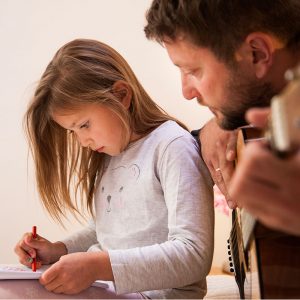

– At times your talks might distract or discourage the child from holding up a conversation. Some examples of conversation closers that you might want to avoid:
Answering your own question: When instead of patiently waiting for your child to speak up, you hurriedly make a statement on his/her behalf. What would you like to have for breakfast today? Let me quickly make you a banana and chocolate smoothie, as I am getting late for work.
By moralizing: Child: I don’t want to bathe today; I just want to play all day.
Parent: No, you have to take a bath, or else you don’t get to play at all.
Use of empty praise or phrases: You are genius! You remember all the rhymes.
Time-passing remarks: Child: Mom can you play with me?
Mom: Only if you do 5 pages of writing first.
Focusing only on safety & rules – Child: amusingly ate the banana like a monkey. He then threw the peel on the floor and pretended to slip, just like he saw it in his story book.
Mother snapped: “It’s dangerous. Never try it again”
By developing communication as a life skill, children can establish positive relationships and learn to express themselves from an early age. So dear parents, lead through example, starting today!
All you need to do this be mindful of the way you interact not just with your kid, but also with people around him/her.
SHARE
Share on facebook
Facebook
Share on twitter
Twitter
Share on linkedin
LinkedIn
Share on whatsapp
WhatsApp
Last Chapter
Next chapter