
Toddlers – Communication & Language
Communication & Language with Toddlers
Chapter 5.9
Share on facebook
Share on twitter
Share on linkedin
Share on whatsapp
Mom: Can you pass my pillow please?
Toddler: “Mama take a pillow.” And also tries to reach the switch & says “Light off”.
Toddlerhood is marked by
– From using single words —- to forming simple sentences —- ans to following simple requests
Let’s Reflect
Toddlers ‘teach themselves’ via everyday interactions especially ‘with you’!
As the child steps into toddlerhood. There is an obvious increase in the ability to communicate. With the onset of language, the child is now able to gather information and better able to clarify needs.
Research on the language development of toddlers has established that stimulating children cognitively, through reciprocal interactions (during play, daily chores, storytelling etc) involving verbal responsiveness on the part of the parent. This degree and quality of responsiveness is associated with enhancements in the child’s language development.
3 rules to having meaningful conversations:
1. Tune-in:
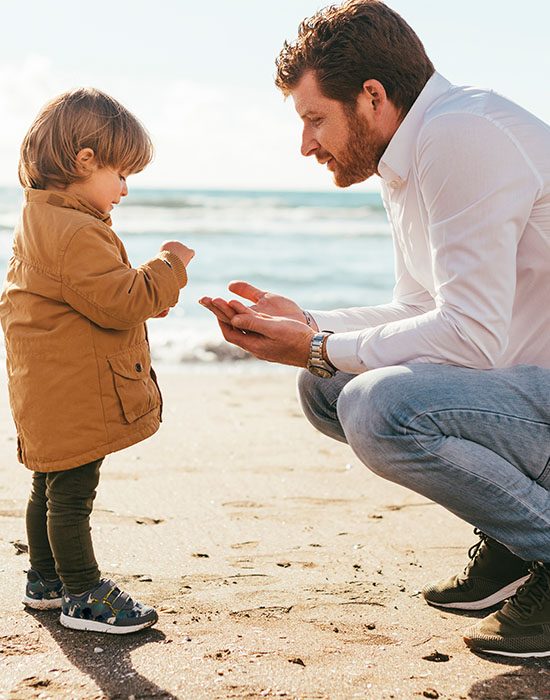
Observe what draws your child’s attention. This will help you strike a conversation related to your child’s interest or curiosity.
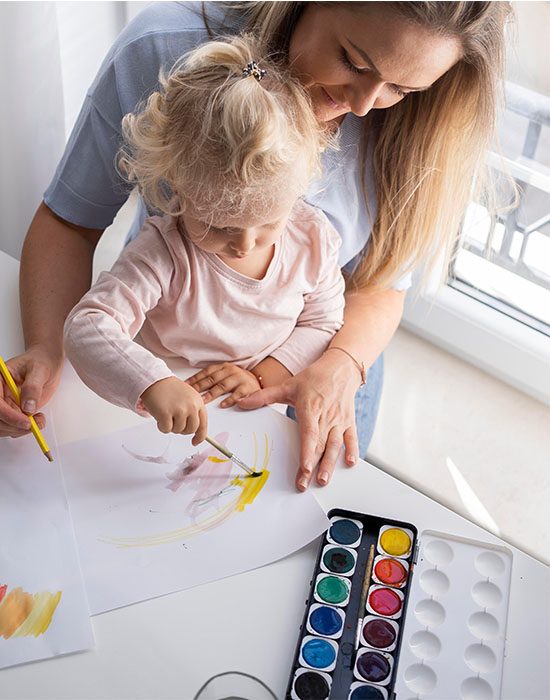
Eg: If you are mixing paints with a brush you could say: “Which colour did the red paint turn into?


2. Give Time:
Encourage and wait patiently for your child’s response. It might be in the form of gestures (like head nods or pointing) or making sound, due to lack of words. Encourage your child to use words, by repeating back what you think your child wants.
Eg: Parent: Why did you mix the colours?
Child: Not knowing the answer, starts splashing paint all over.
Parent: Okay, looks like you do not wish to paint anymore. Let’s keep them back.
3. Pay Attention/Listen
It is very important to send a message to your child that you’re interested in what s/he has to say. Making eye contact, facial expressions or talking back are some of the responses that will assure your child that you are listening!
E.g.:
Parent: So now what do you want to do?
Child: Looks longingly at a colourful empty box
Parent: You want to open and find out what’s inside? Come on, Let’ do it!
Some Ideas towards fostering Communication & Language Development in Toddlers:
Be sure that older toddlers have plenty of experiences to talk about as their world begins to expand. A trip to the local store or walk around the block can spark your child’s interest and result in fun impromptu conversations.
Pay Attention:
Listen to toddlers and encourage them to listen too. Make experiences interesting by striking a conversation around what your child’s interests are or is currently engaged in:
Eg: “Look at the yellow bulldozer in action, picking lotttts of soil!! OR
“Let’s see who can build the tallllllest tower!” OR
“I see a balloon up in the sky so high”. (Disha learns about spatial relationships and the prepositions that go with them).
Play games with sounds and words:
Recite or create rhymes, poems, songs and make sure you acknowledge your little one’s participation.
Eg: Animal sounds are always a hit!
The Lion ROAAAAARS! The Cat MEOOOOOWS,
Describe as you do daily routines:
This will help your toddler remember and connect words with objects and actions.
Eg: I am hanging the clothes to dry in the sun. OR
The dough became flat with a rolling pin OR
Let’s blow some air into the balloon to make it big and round and fly high!
Ask Questions:
It motivates and develops communication skills.
– Requiring decision making: “You want to colour the ball yellow or brown?”
– Open -ended Question: “What all fruits were there at the fruit shop”
– Closed Questions: “Was this chocolate given by your aunt?”
Use questions as important language tools and also encourage your child to ask questions when s/he is fishing for more information.




Opportunities to play:
The more the kids are exposed to varied objects, toys, experiences the more variety of words they become familiar with.
Eg:
– “The telescope is used to see the stars in the sky.
– The astronaut drives the rocket up into the space
– I am the Grufflao child! I will cuddle with dad and sleep.
Introduce bits of science and nature: Eg: The concept of ‘sink and float’ can be a fun outdoor or bath time activity OR How about shadow play under the sun?
This not only will draw your child’s interest but will also encourage fun dialogue about those objects.
Read Books:
Make this time frequent, short, and spontaneous—a fun activity accompanied by lots of cuddling and snuggles. Tips on book reading.
Recognise and Respect your child’s feelings:
Reassure the child that his/her feelings matter and self-expression is necessary to make him/her feel better. Also, remember to empathise with your child’s feelings even when you disagree.
Eg: “I understand you do not want to brush your teeth! But you have to, else all the germ monsters are going to be in your tummy. Do you want that?”
Begin with short, simple, and appropriate requests:
Call your child’s name, or gently touch him to draw his/her attention. Bend down to match eye-levels and then clearly communicate the instruction.
Eg:
For a 1-year-old, you can give one step directions like, “Neel can you please pass me my hairbrush.” Or” Get your napkin to wipe your face”.
For an 18-month-old, you can give two-step commands like: “mumma is in the washroom. You need to wait for her to come out.”
As your toddler’s understanding and language use improves, gradually insert more complex comments and more sophisticated vocabulary. So head on!
SHARE
Share on facebook
Facebook
Share on twitter
Twitter
Share on linkedin
LinkedIn
Share on whatsapp
WhatsApp
Last Chapter
Next chapter