
Module 2
Developmentally Appropriate Practice
Developmentally Appropriate Practice comprises of knowledge based principles as to how young children learn and develop. Nothing replaces your best instincts as a parent and yet, there are moments when you might need something a little more to guide your child or help him/her develop life- skills to thrive.
Children below the age 6 cannot be taught on demand, as they have different learning processes. Therefore, there is a dire need to look beyond academic excellence, towards the holistic development of your child.
“Play is the work of the child”: Play is often perceived to be beneficial ‘only’ for physical and/or social development. However, as per child developmental research PLAY lays the foundation to not just these skills but also other domains such as language skills, thinking skills as well as mastering critical intellectual skills.
Reflecting and incorporating appropriate learning practices through play, will ensure your child has fun while effortlessly gaining maximum benefit.
The Core
Chapter 2.1
Essence of Developmentally Appropriate Practice
Each day in the life of a parent seems to involve a great deal of decision making that concerns the care and development of their young ones .
This is where DAP comes into play as it supports optimal learning and development during the early years.

Hear’em Out
Chapter 2.2
Effective Parent Teaching Strategies
Incorporating DAP into the lives of kids…
Translate everyday interactions with your child into more meaningful ones. Trust us, you will be raising a developmentally ahead kid who has a holistic perception towards learning and life.

The Reason
Chapter 2.3
Determinants for ‘School Readiness’
First thought on hearing “School Readiness” comes reciting ABC, counting 0-9, recognizing colors, and the likes.
But it is not about getting on with a formal approach to education as early as possible. It is about the development of the whole child.

LOVE
Chapter 2.4
Significance of Primary Relationships
A child’s foremost relationships are the ones that are formed with parents (or other primary caregivers). The two are connected with an invisible bond of love & trust through the wavering tides and experiences of life.
Due to the innumerable verbal and non-verbal interactions exchanged between the parent and the child, they both get attuned to each other’s signals and behavior.

Stir-Up
Chapter 2.5
Ensuring Conducive Early Environment
Keep in mind that the environment needs to be dynamic with routines changing orderly so that the overall daily schedule should be predictable and comprehensible by the child. This allows the child to anticipate transition and s/he is mentally prepared for it.
Play It smooth…

Mindful
Chapter 2.6
Take a Closer Look – Assessments
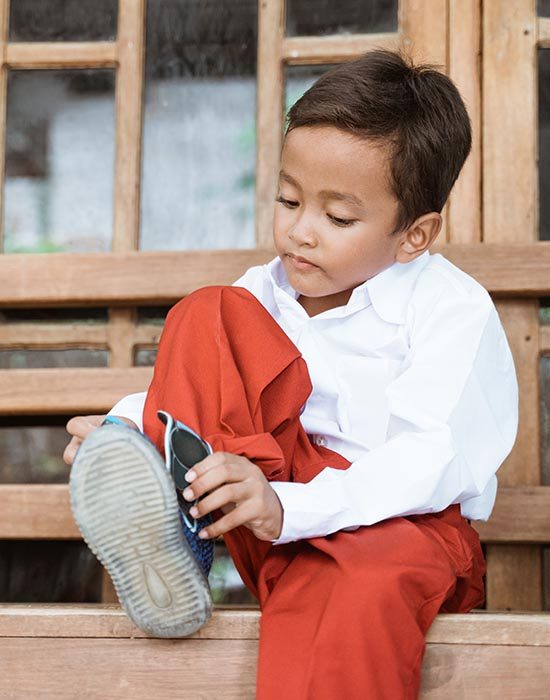
Families are sometimes anxious about their child’s success and achievement in school. They start thinking about which college their child is going to go to, and forget that, the need of the hour is for the child to learn basic life skills – tie their own shoes and the ability to wash hands themselves etc.
READ NOW
Watching You
Chapter 2.7
Raising an Infant
Depending on how parents act towards them, babies develop expectations about themselves and others
Newborn (0-9 months) is a phase of complex and rapidly changing needs, where the child is constantly on a lookout for support and a sense of security.
Mobile Infants (8-18 months) are always on an expedition; eager to explore.

ME & MINE!
Chapter 2.8
Raising a Toddler
Toddlers are trying to make sense of themselves/their identity, and who they are…
As babies move into their second year of life, they become more mobile and more independent, exploring everything they can access. Surely as a parent of a toddler these thoughts must have crossed your mind:

Do Myself!
Chapter 2.9
Raising a Preschooler
By this age your child has developed varied strengths:
S/he might be good with identifying shapes, colors, alphabets, but might shy away from social interactions. Knowing your child’s abilities and providing him/her with thoughtfully planned activities and intentional guidance can help him/her overcome challenges and enhance skill sets.

What/Why/How!
Chapter 2.10
Raising a Kindergartener
Science tells us that brains are built not born
In the centre of this dynamic architecture are sort of skills called executive functioning and self-regulation. These are the key ingredients to life time performance. It is not just about learning language or number or learning colours. We have to work effectively with others, with distraction with multiple demands. These are the skills that contribute to productivity.

The Trick
Chapter 2.11
Play: The Natural bent to Learning
Play is the Work of the Child. Play is a way of recreational engagement for children. The child is free to choose/create/initiate an activity. Children always exercise a certain amount of control over play, or the activity is not play at all.
There is no right or wrong way of playing. What looks simple to parents can be a challenging thing for little hands that are learning fine-tuning moves.
Let’s PLAY
Chapter 2.12
Play bonds us further, Mommy and Daddy!
Parents are the foremost and most preferred playmates for their child!
From the moment they open their eyes into this world and feel the warm touch of their parents, little nuggets use their twinkling eyes and loving smiles as means to engage in play with them.

Not ABC’s
Chapter 2.13
Play is the Preparation for Life
Play is the most effortless way towards building active, healthy bodies during the formative years of childhood. Brain research in recent decades reinforces the notion that children are innately competent.
Let us look at the how parents can harness and catapult benefits of Play during early childhood:
DAP = PLAY
Chapter 2.14
Ages & Stages of Play
For parents, having a general idea of how kids’ play evolves can help answer a lot of their play related concerns and queries (Hey, that fire truck obsession is normal!), as well as help them curate age-appropriate toys and activities.
What are the Six Stages of Play?