
Toddlers – PSED
Enabling Environments for Toddlers
Chapter 5.5
Share on facebook
Share on twitter
Share on linkedin
Share on whatsapp
Aarav has come out from the shower and wishes to get dressed himself. The toddler picks up his trouser and juggles several times before managing his legs inside only to find out that both his legs were in the same hole!! Dad intently watching pitches in and helps him pull out the wrong leg whilst explain the concept of “left leg & right leg” to him.
‘That’s right, take out your left leg – now – can you put it in the other side, in the trouser leg?’ Aarav got his leg in the other trouser leg and smiled.
Dad gestured the action of pulling up trousers as he said:
‘Good boy – now, pull them up – oh, where are your feet? I can’t see your feet.’
Aarav pulled the bottom of the trousers up to reveal his feet.
‘Oh, there they are! Can you stand up now – that’s it – pull them up to your tummy.’
Aarav stood up and pulled his trousers up as he said, ‘Yes! I can do it!’
‘That’s great! Well done, Aarav. Now, let’s get your shoes on… says dad
Let’s Reflect
It is painstaking but an absolute must – Support your child’s growing independence without taking over
Inculcating self-care skill is integral for personal, social and emotional development as it contributes to the child’s growing self-esteem and confidence.
In today’s demanding lifestyles it is less of a task get over quickly by doing things for the child. Such as: keeping away the toys, wearing shoes, self-feeding are some common scenarios. It is a pain-staking to let the child try at having a go at things themselves. This requires both time and patience as several attempts might be required before the tiny humans get it right for themselves!
Sometimes very small changes can have a huge impact on children’s experiences. So, if there is a good understanding of how you would like things to be, it is easier to plan steps to achieve your desired goal.
Planned experiences and activities are both supporting and challenging in-order to maintain an upward trajectory of growth and development.
Young children are individuals with a unique composition and abilities.
Learning environment (both indoor & outdoor spaces) should ideally be both rich and varied and secure and safe. It enables the child to explore and learn with confidence. Planning commences in accordance to the inferences drawn out of observation (of the child’s current interests, development and learnings). This helps you to not only know what your child is learning but how he/she learns as an individual.
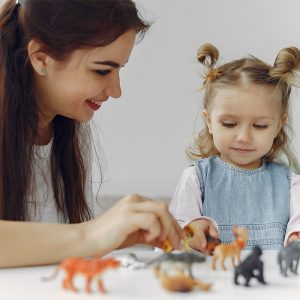
Some keys aspects to fostering enabling environment
- Repetition is good:
Parents often do not get as to why the toddler keeps repeating everything he knows.?
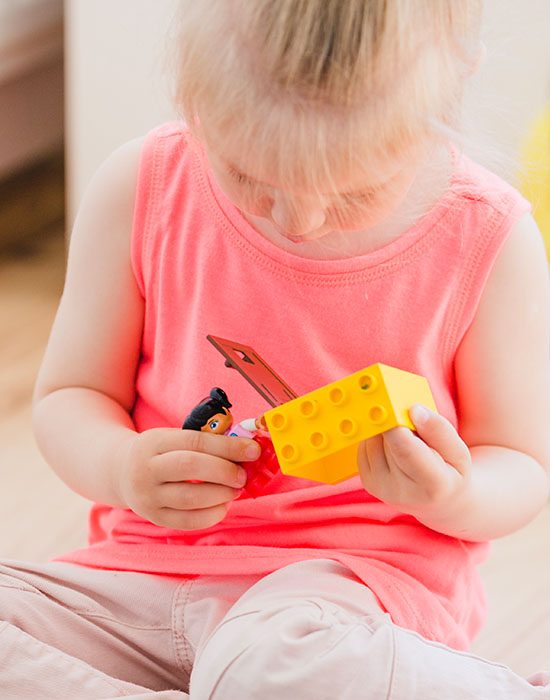
Eg: Is able to join two blocks. Takes out and joins it back again and again and again. Scientific research confirms the need to repeat experiences in order to strengthen connections in the brain.
- Need permission:
Notice your toddler look at you with puppy eyes on seeing a balloon. He is seeking for your permission before going all out and exploring it.
Eg: He might use a bat to hit it, or balance them on board or just simply try them blowing out. This way by changing or combing other resources he recreates experiences for himself.
- Plan activities which can be explored over a period of time. This gives them an opportunity to come back and explore in greater depth. How about seed germination?
- Process over Product:
Remember it is the process that builds on and enriches their skill, so ensure activities experiences that focus on the process and not the end product/result.
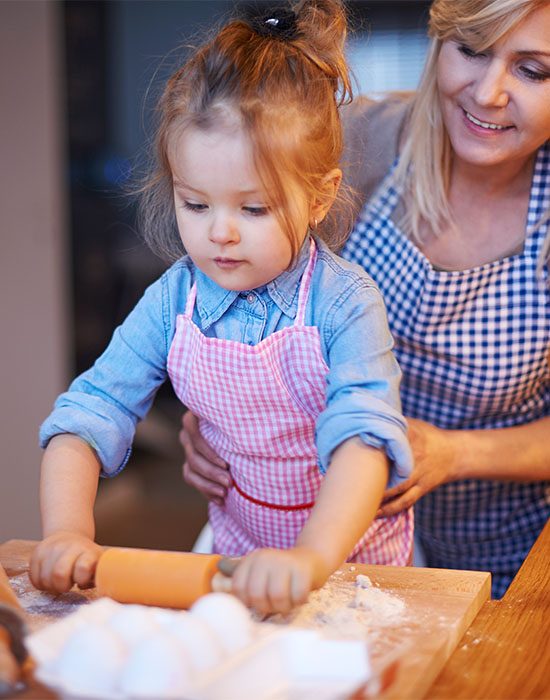
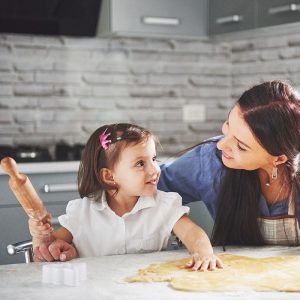
Eg: Rolling, squishing, pressing, folding, hammering of the play dough is important for those little fingers to gain strength and also to their creativity. Not being able to make that perfect cake is perfectly fine!
- Take a Back Seat:
Provide age-appropriate interesting objects for toddlers to experience and explore on their own without your interjection. The child needs time and opportunities to get engrossed into what they are doing, until his/her curiosity gets quenched. - Encourage active learning:
There is nothing like hands on learning. Ensure both repetition and introduction of various patterns such as transporting, connection, enveloping, scattering and positioning. Such opportunities allow the child to problem solve, question, predict, imagine, speculate and develop independent choices thereby constructing meaning in what they are doing.
Eg: Rotating car wheels, toy aeroplane blades, spinning a top. How they stop on touching. How each one of them have different shapes and purpose… and so on
The major Constituents of Enabling Environment:
Emotional Environment is all about the atmosphere or mood in the area. How people talk amongst themselves, the behaviour of the adults around.
E.g.: The way you:
– greet people who come visit you home.
– show respect to elders?
– The house is full of chitter-chatter…
– Is the young child being given his/her due attention.
Physical Environment (Both Indoor & Outdoor):
The Reggio approach also recognises the environment as ‘a third teacher’. The physical environment in a setting impacts directly on the quality and extent of learning and development. Therefore, it is critical to not only plan but regularly review the environment with the growth of the child. Some of the questions that can help:
- Is the space welcoming and exciting to be? Besides keeping the environment clean & tidy, stimulate young minds by display of posters, photographs etc. Do not forget to observe the environment from the child’s height, will s/he be able to reach/view the resources around…
- Does the environment support play in its various forms? Being hands on, creative, reflective or maybe solitary. Rearrange the environment to create distinct zones: for e.g a reading corner where s/he needs to be quiet. Or an outdoor wall, when the mood is to let imagination flow via hues of different colors.
- Does it support the development of physical skills? This is the age they discover being mobile – crawling, toddling. So, the floor needs to be clear for them to freely move around. Providing hand hold mobility aid furniture for toddlers is of great help.
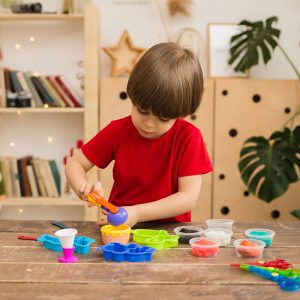
- Does the environment entail sensory stimulation? Try including natural objects like flowers, twigs, stones, water, building blocks, nesting toys, stick and utensils to bang and create sounds, water and ice, sticky dough and so on.
- Does the environment support my child’s growing ability and independence? Create a space which is within their reach. Be it dragging their own chair, choosing their story book, pulling out their clothes, arranging their toys and so on.
Do keep a tab as to what impact have your changes had on your child! E.g.: While you read your toddler quickly grabs her book, kept handy at shelf of her height. With the child’s growing abilities there will be a need to review & rearrange the settings. E.g: Now that he is able to take few steps, and soon will be a confident walker, resources that will encourage him to stand will be helpful.
If an area is not well used, consider why and redevelop it. You can have a safe space in the kitchen to let them touch, smell, see and explore fruits, vegetables and son.
Most importantly, have fun and cherish these transformational moments.
SHARE
Share on facebook
Facebook
Share on twitter
Twitter
Share on linkedin
LinkedIn
Share on whatsapp
WhatsApp
Last Chapter
Next chapter