
Learning Stories
What is A Learning Story
A Closer View of Children
It is about documenting events (in the form of a story) that are significant ‘to you’ about your child’s day to day experiences in the form of photos or videos. Penning down an informal description of what your child can do and is doing rather than what they can’t do.
As a storyteller you bring your perspective to tell-a-tale about the unfolding event’ in your child’s life.
There is no “right way” to tell a story,
The blank canvas of a Learning story allows you to:
- Be present by heart and pay close attention and discover what is happening, there is no specific objective.
- Provide an opportunity for you to bring others (fellow parents, educators, propagators) up to speed and to seek their interpretation.
- Create learning visibility, giving squad members enough of an understanding to make their reactions to the learning more meaningful.
Together, you can –
discover or uncover the meaning you see, look for what emerges that you haven’t seen before, connect it to prior events or insights from others, to support your child and plan for his/her future enriching experiences.
Some examples of significant events:
Physical Development:
When you come across an apparent new interest, skill, new preferences, new acts of your child.
Socio-emotional
New behavioral developments, shifts in behavior, troublesome behavior, trying to make new friends, looking for approvals, interesting conversations, exaggerated reactions
Language & Communication
Recording those first sounds, words can give significant insights into your child’s developmental progress in the domain.
Manifestations of the developing mind
Symbolic play, problem-solving, critical thinking, creativity & imagination
To delve deeper into your child’s way of learning
Persistence, self-regulation, curiosity, engagement, learning dispositions and so on…
How are Learning Stories different from observations/ assessments/ checklists?
Learning Stories are not just jotting notes or checking items off a list! they are a new view of your child!
Learning stories redirects attention, away from the assessment tool and back towards the children i.e. it’s, “the child that tells us where to look, while the assessment items inform what we see.”
Here you are solely focused on interpreting the “Whole Child”. Talking about the developing outcomes – learning skills, habits and dispositions – what new experiences can be presented to build on this story for the child’s future.
This is in contrast to checklists where the focus tends to be on pinpointing where a child sits today on a developmental profile – because that is the task at hand, the output required.
In observation the focus is on a specific skill and what steps the child takes in order to complete that specific skill. Learning story is about your child’s conversations, interests, skills, attitude etc that unfolds when the child interacts with the environment or with others… This can be only done by some who knows the child inside out – Yes, the proud parents!
In observations you describe exactly what the child does such as “Sapna, picked up the pencil with her left hand using a palmer grasp began to write the first letter of her name…” With a learning story, it differs as you write it like a story. “This is Sapna’s third attempt to write her name. She is determined to get the tricky ‘S’ right…”
How Can It Help?
From birth to age 6 is a period of rapid growth & development, and learning stories is a strong indicator to show that all the learning happens at a young age. Stories keeps your moments alive and allows you to join the learning dots.
- Identify pace and style of your child’s development which might have been otherwise overlooked. This can be a major contributor for you to optimize your course of action.
- Helps you to interpret and understand your child’s current strength, interests, and developmental stage.
- It highlights where the opportunities lie to build on strengths or interests to foster better learning outcomes.
How to Write a Learning Story for Your Child?
It’s recommended that you talk about yourself in first person using “I”. This gives you an opportunity to put yourself in the same experience as your child and describe what you watched and discovered.
Step 1: Inception – How it All Began…
Upload photo(s) of your child during the experience. It’s beneficial to use photos as it helps to create the story and the more details you can convey to your audience.
Start off by talking about when, how, where the experience took place, describing the events that led up to the experience.
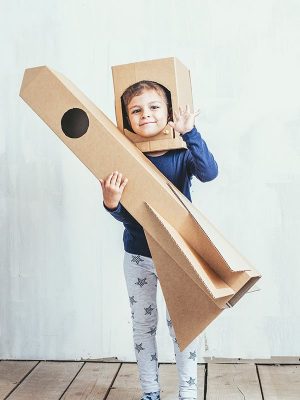
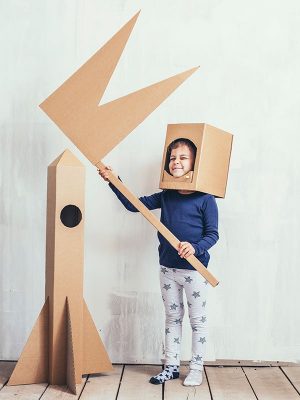
For example: Vivaan has always been more interested in the carton boxes in which toys came than the toy. Today, we received a gift from grandparent and yes it was a toy. So, this time instead of focusing on the toy, I decided on extending his experience with the carton by introducing some pretend play with it.
Step 2: Details – The significance of the event
Move onto the events that happened during the experience. Mention the conversations and interactions, describe what the child did through the experience, describe about your involvement in the experience, describe the reaction, the scene or the event in detail etc. Simply put – try to describe what the child says and does.
For example: I tried to use it as a slope for his cars. So. holding the cardboard by one hand I tried sliding the cars down. “It’s my turn now” – Explained little V. So, he took the carton slope from me and looked around. Searching for an object to support his slope. He then dragged a slightly bigger sturdy box of toys towards me. Kept the carton slope in a slant and asked me to hold from the top, so that it doesn’t slip away. Oh! you should have seen the joy on his face. It was no less than an achievement for him. He zipped the cars down the slope. Offered me to do the same. Caught a new word “bumping” while I was constantly consciously using it.
Step 3: Engagement – Seeing the Whole Child
This is all about the Outcomes:
Vivaan was thrilled how I got involved in the thing of his liking – the carton, and also suggested a fun play. He picked up a new word. He figured out on his own how to support the slope. This indicates his developing problem-solving skills.
Step 4: Reflections – Good time to give your story a title (What it Means!)
Reflect upon dispositions of learnings: curiosity, cooperation, confidence, creativity, commitment, enthusiasm, persistence, imagination and reflexivity.
For e.g.: Vivaan was co-operative during play but not very confident of the words he wanted to describe his feelings during play.
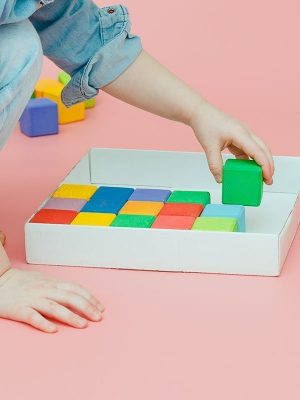
Upon his/her ceiling of knowledge: for e.g. – he could stack up the blocks but needed assistance to arrange it from biggest to smallest
Step 5: Extension of Learning – Thinking aloud the way forward…
Learning event will impact future learning and ways to extend learning from this moment. So, next comes reflecting on how you may want to extend, scaffold, support on the interests, abilities, understandings and play that have been demonstrated throughout the learning story you have written. Planning on how changes in routines, interactions, or learning environments might impact your plans for what’s next for your child’s learning.
For e.g.: Next I want him to come with his own way of using the cartons. Maybe a ‘garage’ for his cars, or maybe he could turn it into the ‘headquarters’ for his action heroes.
Step 6: Share – Open to Squad Perspectives
Put it up for squad member. People who care and are happy to know about the unfolding event in your child’s life. You might get perspectives you overlooked, some ideas to plan ahead, or just be an inspiration to another parent, or might want to discuss privately with an expert upon some developmental suggestions. Whatever it is, it is bound to bring direction and empowerment to your life as a parent. Try building into the habit of being a Storyteller….