
Kindergartner – Math
Math for Kindergarten
Chapter 7.12
Share on facebook
Share on twitter
Share on linkedin
Share on whatsapp
Young children use their mathematical instinct of comparison and quantification, even though unaware of math concepts.
Crying, on not seeing her mother’s familiar face is a classic example of newborn’s comparison instincts.
A 2-year-old will pick the bowl with more candies than the one with a single candy, when given a choice.
A 5-year-old will be proficient at mentally counting single digits. giving two bananas and one apple when asked to bring 3 fruits from the fridge.
Let’s Reflect
If introduced in the right way, early math can rewire your child’s brain for growth mindset, better problem solving and build positive attitude towards the most feared subject.
Worry not! You do not need to be a rocket scientist, just a little change in the outlook and mindset would do the trick!
Stint with 3D Structures
The following example show the child’s development and reflection on her mathematical understanding – not only about shape, but also pattern, locating and counting.
6-year-old Stuti and her twin brother Anuj were decorating their Christmas tree. Mom & Dad joined the fun and showed them how to build a pyramid out of it!
“Let’s put the star on the top! That’s a good idea Anuj. Let me place the star at the apex of the tree,” says Mom
Stuti says: “Mom, can you help me balance the snowflakes and reindeers across the tree?”
Dad went ahead to give the final touch with fairy lights. He asked mom to help him wrap the wire around the tree at an angle so that the lights are equally distributed.
Anuj switched off the main lights, to see the tree glow. Anuj could see a giant hand over his head in his shadow. Stuti, burst into laughter.
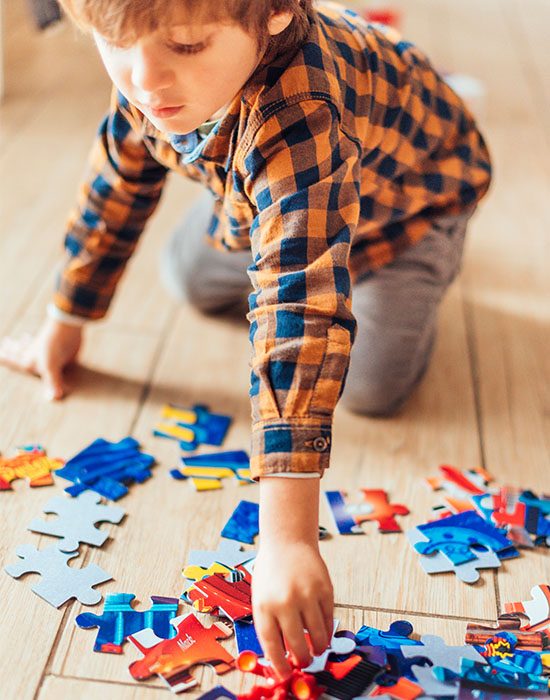
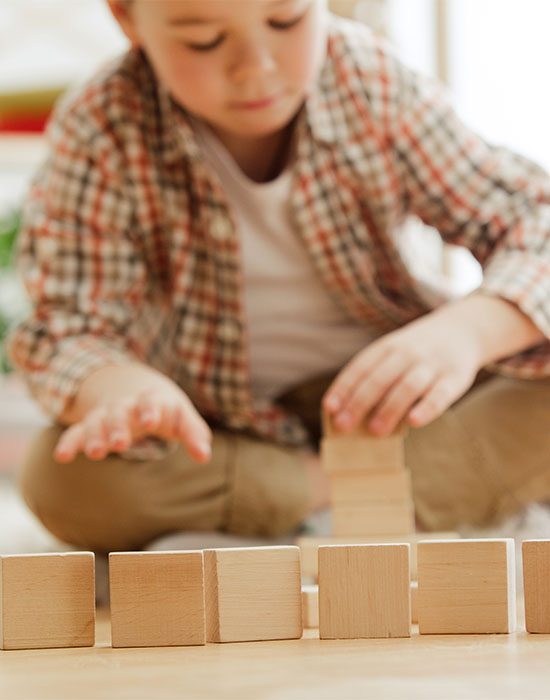

Use natural objects to incorporate intentional numeracy learnings.
For example, walnut shells, pea-pods, pistachio shells, leaves, twigs etc can be used to make patterns, shapes, sorting by size and weight, and counting. Parents could encourage the conversation about numeracy by asking questions like:
How long can you make it? Can you also sort the pea-pods on the number of peas inside? or by their colour variation? or can you set aside the ones that have holes because the caterpillar ate it? Can you match my pattern? Can you make a different pattern? How many? Can you stack them?
Below are some more ways to make extended and scaffold mathematical learnings in several different and meaningful contexts.
Support your child’s learnings: measuring, estimating and comparing
– You could experiment with multiple ways of measuring things:
- How many times did her balloon fall while trying to balance it in the air?
- How long he could dance on a beat?
- How far could she jump in the sand?
- How many spoons of sugar goes into her sweet lime?
– Show him/her different ways the measurement information could be presented:
- Markings on a wall to measure & compare height of dolls and the child.
- Drawing the outline of your foot and that of your child on different sheets. Using a ruler, or any linear object, teach your child how to measure the length, and compare the difference.
- How about palm printing to teach measurement? It is fun, needs balance (gross motor) and teaches math! Let your child carefully dip his palm in paint and place one palm exactly in front of the previous print. Then count the number of handprints on the line. Make him/her notice that you require a lesser number of handprints. Ask why!
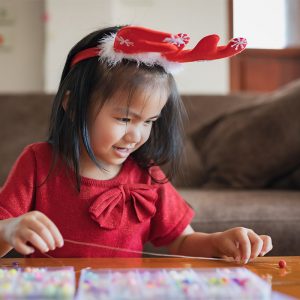
So, should one leave the child to initiate engagement independently and at random?
Parents play a critical role in maintaining balance and compatibility between child-led learnings and deliberate teachings. A kindergartener has to be inspired and engaged in mathematics. Parents should not just effectively notice, recognise, and respond to their child’s immediate and obvious interests, but also should deliberately extend and scaffold their child’s deeper learning and understandings.
SHARE
Share on facebook
Facebook
Share on twitter
Twitter
Share on linkedin
LinkedIn
Share on whatsapp
WhatsApp
Last Chapter
Next Module