
Preschoolers – Math
Math for Preschooler
Chapter 6.13
Share on facebook
Share on twitter
Share on linkedin
Share on whatsapp
Does the following sound familiar?
“Mom look! so many fishes on this page! Let’s count them.”
“I have three more pots to paint.”
“Look Mom, I stacked those blocks so high—it’s now a tall tower!”
“Can I get two pieces of cookies please?”
“Let’s climb up and down the red steps: UP: one, two, three. And DOWN: one, two, three.”
Even without guidance, most preschoolers naturally talk math, as if they always knew it!
Preschoolers love to ask questions and play games that involve the many aspects of math. Dynamic engagements, hands-on games and projects, is their route to informal mathematical learnings and applications,
Early math is not about how to count, recognize the numbers and add or subtract them! Your 3 or 4-year-olds should not be rushed into these.
Let’s Reflect
By the time children enter preschool, there is already wide variation in their math knowledge (Dowker, 2008; Klibanoff, Levine, Huttenlocher, Vasilyeva, & Hedges, 2006; Starkey & Klein, 2008). Children gain critical information from their environment that builds on their mathematical understanding of the world.
A child’s early experiences with math at home, sets the stage for their later achievement in school, pointing to the importance of providing rich opportunities for young children to engage in math from an early age. By preschool years, it is important to focus on math learning in both formal and informal learning environments.
What math knowledge will your child need in elementary school?
- Understanding size, shape, and patterns
- Ability to count verbally (first forward, then backward)
- Recognizing numerals
- Identifying more and less of a quantity
- Understanding one-to-one correspondence (i.e., matching sets, or knowing which group has four and which has five)
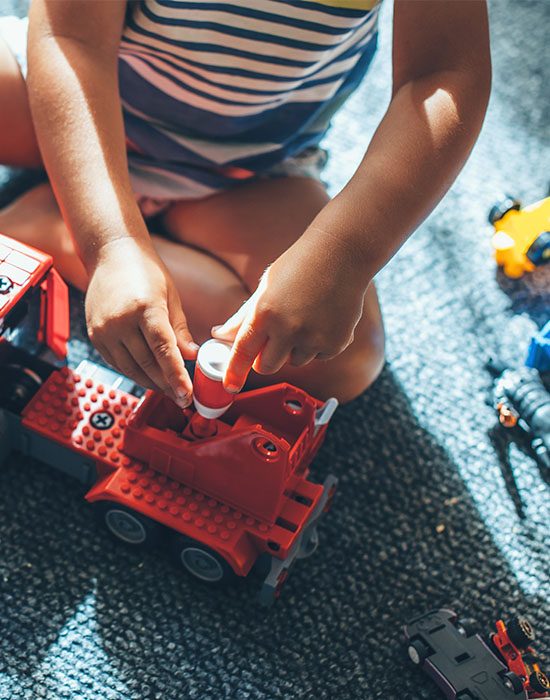
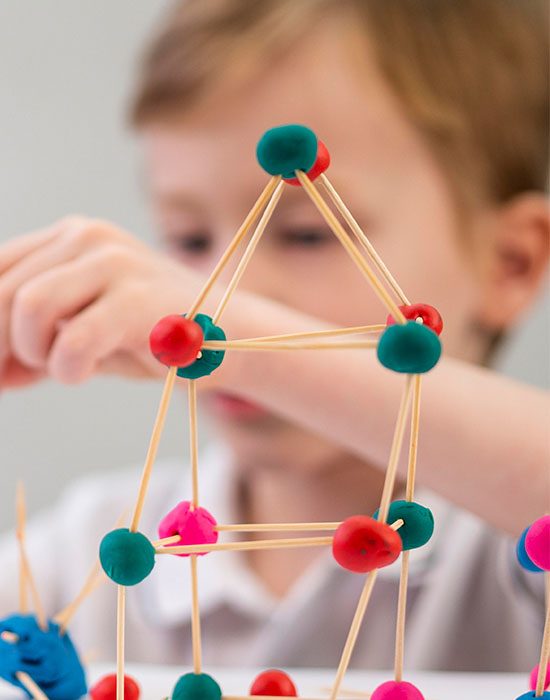
Stages of learning any mathematical concept are concrete, pictorial and abstract
The Concrete Stage:
When the child understands the concept of number by physically holding an item equivalent to that number. This can be initiated in the first year of your baby. While playing with concrete objects with your child, using words like ‘one object, too many, less, more, plenty, some more, not enough, how many’ will help your child organically form the concepts. This is far more meaningful to a young child than looking at numbers on an activity page. With time, the child naturally learns to recognize them and know how they are formed.
The Pictorial Stage:
It is when the child is able identify that a picture of objects and understand that it represents real objects.
E.g.: When the child sees the caterpillar eating 5 strawberries in the story book, he understands it is a representation of actual 5 strawberries. Soon this graduates to the understanding that if s/he wants 5 oranges and has only two in his/her basket, s/he needs to pick 3 more to make it five.
The Abstract Stage:
When the child can look at numeric e.g. 5+3, and is able to add them without concrete objects or pictures. The child has matured enough to understand 5 & 3 are a representation of the number of objects to be added.
Understanding concepts concretely, makes solving abstract problems much easier!
Preschoolers are mostly in the concrete stage. In fact, until grade 3 or 4 any new concept should be introduced only the concrete way before moving onto books or worksheets with examples to solve.
SHARE
Share on facebook
Facebook
Share on twitter
Twitter
Share on linkedin
LinkedIn
Share on whatsapp
WhatsApp
Last Chapter
Next chapter