
Kindergartner – PSED
Personal Development In Kindergarteners
Chapter 7.2
Share on facebook
Share on twitter
Share on linkedin
Share on whatsapp
Uday was visiting his grandparents and was excited to tell them about his recent visit to the zoo.
His dramatic description went like this:
“The monkeys were making uu—ee—uu sounds. He wanted the girl’s food, and did like this (imitates) to take it
The bear was brown and big. It growled loudly and I got scared (displays in action too)
Apes were so funny. Look grandpa how they walked (imitates and squeals into laughter)!
Grandma I touched the lamb! she was so soft and furry, (chirped excitedly) but the llamas smelt stinky (holding his nose), so I did not go close to them
I saw parrots of so many colours. The rainbow colours (his term for so many colours)!”
Oh, and I saw the danger signs (gasps). Crocodiles were in it, and their eyes were shut…”
Let’s Reflect
There is an emotional involvement and the meaning attached to the above expressions. This displays the development of different capacities of the 6-year-old’s: memory, attention, oral, written language, and self-control. These are some of the superior psychic functions that are strengthened by this age group, directly interfering with the development of personality.
The real basis of a man’s personality are the relations that occur and that are established by the set of his diverse activities” (Leontiev, 1978, p. 143). What does that mean?
When children engage in meaningful tasks, when they know the reason and purpose of their actions and make emotional moves toward achieving their goals (refer to the above stated zoo example), they are performing an activity.
For this reason, they develop their capacities fully. In the process they gradually and progressively become aware about the motives for their conduct (Leontiev, 2010) In the above example the detailed narration given by Uday was to express his thrill and wonders of the visit to the zoo!.
Personality is a complex formation of human psychism (Leontiev, 1978) that comprises: cognitive capacities, emotions, will & character traits.
A Kindergartner’s personality has matured enough to gauge varied possibilities, they become aware of the reasons for their conduct and are capable to actively dominate self behaviour.
E.g.: “While waiting for dad to finish work, I can get something to eat or I can play with grandma instead. Grandma seems busy in the kitchen, I want to eat a juicy apple. Opens the fridge and picks out the most red one.”


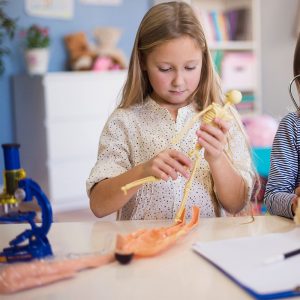

Kindergartners are now able to externally imitate the actions of the adult without putting themselves in his or her place.
Early childhood is a spontaneous period of first level of personality development (Leontiev, 1978). It is in the first year of life the child picks up values, learns about conduct of appropriate behaviour specifically to human capacities, and becomes capable of expressing themselves in a singular manner before the world. By age 5 (depending on his/her life and education conditions, activities s/he develops as a result of undergoing learning processes) the child develops a complex consciousness about:
- the knowledge with respect to their environment,
- human relations
- themselves
In case of a make-believe activity:
A 3-year-old would cradle a doll and still sees it as a doll. But by age five they have levelled up the game by creating an imaginary situation. So now the doll becomes the daughter and the girl is the mother.
They become capable of thinking, and being moved, and motivating their behavior by words, which represents an intense sophistication of their possibilities of relating to and comprehending the world where they live.
It is worth remembering that their relationship with their surroundings has changed proportionally to the development of their capacities. They are able to comprehend facts and themselves, in an entirely new way. It is fundamental for parents & teachers to aware about this critical turning phase of child development. For only then will they be able to prevent crises (Vygotski, 1932/2013b) that happen when there is a deep gap between what the children is already able to do and what is effectively allowed by the adult. In this context, if letting children solve everything by themselves is not a possibility, the adults can present options so that the former make choices.
The important thing is that children take a new position in the relations, that they are no longer treated as babies, and that they exercise, as far as possible, their autonomy.
Role of the Parents: Mediating means
Although essential, role-playing games are not solely responsible for learning during the early childhood phase. For the holistic development of their child, parents need to promote meeting between the following 2 elements:
- Objects of learning (such as: drawing, orality, movements that promote body awareness, painting, molding, math knowledge, music, writing and reading)
- And the child whose curiosity is provoked thereby leading to the development of superior psychic functions.
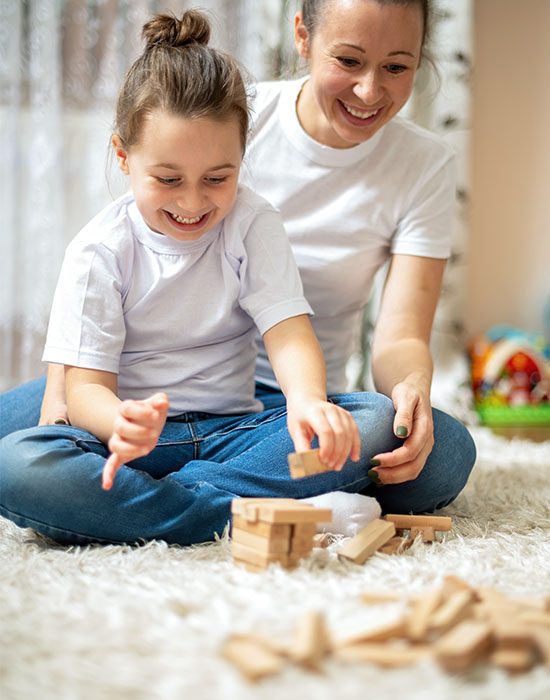
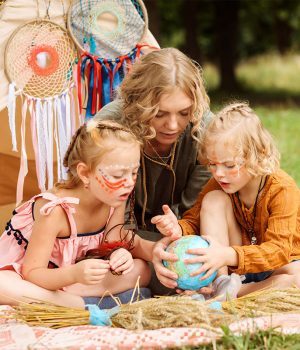
Engagement in diversified and meaningful activities leads to the development of intellectual, affective, practical and artistic capacities of child personality. it is not about putting the child beside the material objects (such as books, blocks, paper, crayons, ball, cars, paint, etc) or non-material objects (like numbers, reading, writing, music and diversified forms of human expression) for them to discover and build knowledge on their own. The parent needs to familiarise the child with the use of objects according to their social role. Knowing about them and thinking about them in an increasingly autonomous manner.
Eg: – Books are followed by manipulation and reading procedures culturally defined
– Games have set rules
– Movements (such as music, painting, sculpture, drawing, sciences) have meanings
The child is motivated to be involved in expanding their knowledge owing to the result of actions s/he performs thereby getting physically, emotionally and intellectually involved.
Therefore, it is through these experiences the child comes to know about himself/herself and his/her capabilities
Eg: Mother introduces the uses of scissors to open packets. The child picks it up quickly as he no longer has to be dependent to open gifts, chocolates etc on adults. He has now gained another capacity of self-reliance.

SHARE
Share on facebook
Facebook
Share on twitter
Twitter
Share on linkedin
LinkedIn
Share on whatsapp
WhatsApp
Last Chapter
Next chapter