
Preschoolers – PSED
Personal Development In Preschoolers
Chapter 6.2
Share on facebook
Share on twitter
Share on linkedin
Share on whatsapp
As a toddler making Vinay sit down to flip through books was a like a task. Being full of energy coupled with eagerness to explore he had little interest in books. His parents, then adopted a strategy. They expended his energy in the park mingling with other kids and enjoying the outdoor spaces. On returning home, exhausted Vinay succumbed to sitting at one place and playing. That is when his mom introduced him to the pictures of his interests: animals, vehicles, rockets, planets and soon, Vinay got interested in flipping through pages. There was no stopping him from there then.
Preschoolers see themselves and others in a “this or that” perspective
They see and define themselves primarily in physical terms and Marshall, 1989). You might often hear your child describing himself/herself in terms of physical actions such as, “I can jump high, just like Pocoyo does ” and “I am a big boy. I can wash hands all by myself” or physical traits such as “I am a girl and I have long hair.”
Occasionally preschoolers may go on to list their likes and dislikes (Marshall, 1989). such as entirely good or bad and do not understand a person may be both at the same time. Eg: “I want to read “The Gruffalo’s Child again, please… I like it, it is so cute!”
Let’s Reflect
Often pondered over the question: “What kind of a person will my child become?”
Caught yourself looking for clues via his/her responses and characteristics that will help you formulate an idea about your baby’s personality? Yes, subconsciously, you are on a look out about your baby’s emerging style of behaviour popularly known as temperament; a biological disposition.
But wait there is another equally (if not more) influential factor to shaping early emerging personalities.
A new-born that parents once gazed upon, becomes a preschooler with visible gradations and depth in personality!
Even though by this age-group major parts of the personality have already taken shape, but it is not rigid and has a room for evolvement.


Attaining Self-control:
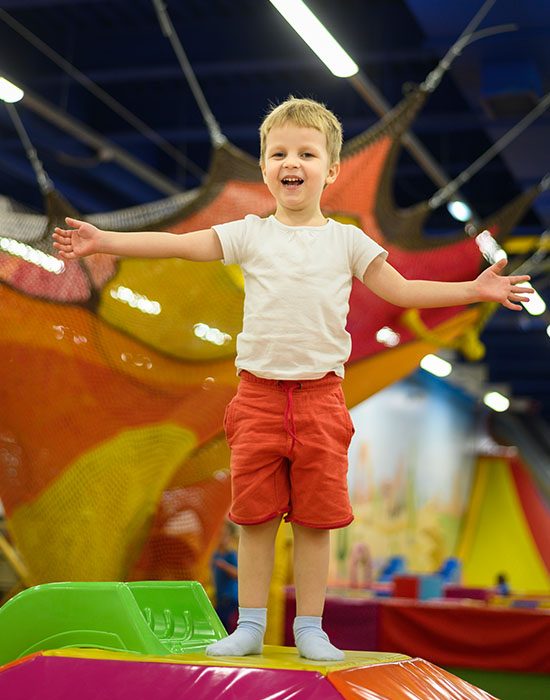
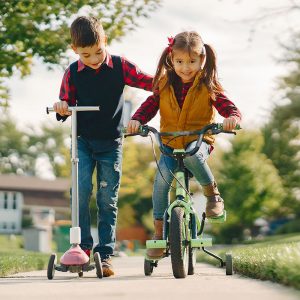
By ages 3 to 5 brain-based capacity to self-control has advanced. S/he strives hard to attain self-dependency which means relying less on adults around. Are able to emotionally regulate themselves in moments of excitement, fear and being upset.
Eg: A new-born known for frequent whining might not necessarily turn into an insecure personality. Consistent parental support and responsive environment can ease away the insecurity. Result – by pre-school years you might have a self-reliant and socially active child.
Building their Self-confidence:
Engagement with the surroundings and individuals helps the young child gain lots of experiences. These experiences help them formulate an understanding of themselves. Following are some of the broad constituents in building up young personalities:
– His/her developing self-image,
– His/her sense of responsibility
– His/her values and conscientiousness,
– His/her willingness to socialize,
– His/her motivation to achieve
– His/her coping mechanism
Since birth personality development begins with the biological foundations of temperament.
However, it is through early experiences that these temperamental characteristics get changed, refined, or gets increasingly elaborated or extended thereby shaping actual personalities.
Trying to Change/Mould Your Preschooler’s Personality? Think Again!
Biological dispositions are certainly an influencing factor. However, the early childhood experiences also exert significant impact towards the formation of individual characteristics.
Hence, instead of trying to infuse some particular personality traits into your child, pre-schoolers should be allowed to be themselves, engage with the world in their own way. And in doing so, all they need is to be consistently encouraged to indulge in activities that further stretches their emergent personalities. Parents should focus on curating experiences that support his/her growth in new directions.
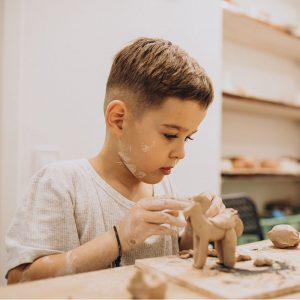
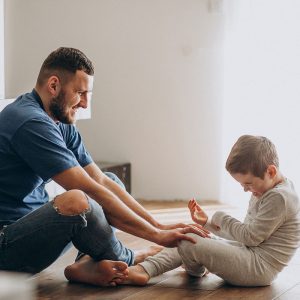
Healthy personality development is nurtured through sensitive and responsive parenting which keeps in mind the individual strengths and needs of the child.
- Enjoy and cherish your child’s discrete qualities and strengths. Parents should strive to maintain a loving and supportive environment, even while figuring out the response to his/her challenging behaviors.
- Support your preschooler’s interests and assist them into exploring their likings further
- Model the intended behavior: parents are under constant observation by their little detective, who also happens to be subconsciously picking your ways. So, it is important that you are mindful of your actions and words.
- Avoid labelling: Using words like shy, emotional, mean, angry, can carve out a view about their own self-image. Hence, avoiding labelling let’s them define their personality through self-exploration.
- Promote Play: As it teaches them the art of being social, problem-solving, decision making, role playing, being assertive, speaking their mind, co-operation, conflict resolution and so much more!
SHARE
Share on facebook
Facebook
Share on twitter
Twitter
Share on linkedin
LinkedIn
Share on whatsapp
WhatsApp
Last Chapter
Next chapter