
Early Learning & Development
Sensory Integration: The hidden dimension in learning & development
Chapter 3.5
Share on facebook
Share on twitter
Share on linkedin
Share on whatsapp
Tickling precedes language development, and in a sense, is a form of first conversation—how we manage to talk with young children…!
What if a baby is ticklish? He is unable to vocalize his heightened discomfort caused by these strong invisible forces (not knowing what tickling is). In such a case, his only way out is to “over” or “under” react, external behaviours being the only means to articulate the uneasy sensations.
Let's Reflect
What does it mean for parents?
The way our nervous system deals with sensory input can influence many aspects of our being: from motor skills, cognitive skills, learning and our perceptions of the world. Each day, parents face difficult situations as they respond to their child’s difficult behaviours.
When you support the way in which your child’s sensory system works, you are supporting his/her capacity to function successfully at home, in the classroom and in the community.
Understanding why your child’s behaviour changes is not necessarily an easy process.
This is not only since sensory causes of discomfort are hidden, but also because medical practice does not recognise the need to address the side effects the senses can have on young minds
It is important for parents to help their child figure boundaries that are established in space and through the senses.
When your child’s behaviour changes the parent needs to turn detectives to figure out what in his/her experience is unusual. Ask themselves questions related to his/her experience, to his/her behaviour, and to their social and cultural dimensions:
- If at home, is it happening in a specific area or social situation?
- If outside the home, what new stimuli has been introduced?
- Who was around?
- What are the feelings of the baby?
- Is the room hot, cold, full of technologies?
- Did the child react after eating? or
- Coming back home from a lot of stimuli? Etc.
By exploring and analysing the following three different sensory processes parents can drill down the reason behind sensory discomfort of their child:




1. Sensory Processing...
…is a neurological process that includes three steps:
- Recognizing sensory information from any sensory systems;
- Interpreting the sensory information;
- Creating a motor response to the sensory information.
In order to eliminate the sensory toxins from your child’s environment as much as possible, parents should take time to learn and study their child:
-what are his/her sensory stressors
-what behaviours relate to which stress and
create a ‘sensory sensitivity’ chart to understand which aspect of sensory processes requires to be addressed via a sensory diet.
2. Sensory Integration…
…enables the nervous system to work together, for the child to effectively interact with the environment and experience appropriate satisfaction. Sensory Integration “use” affects the child’s:
- perception of the body or the world
- adaptive response
- learning process, and
- the development of some neural function.
NOTE: Sensory processing influences the motor responses, whereas sensory integration affects cognitive abilities: perception of the world and learning abilities.
“Out of Sync”
The “Pyramid of Development” developed by Taylor and Trott (1991) shows the importance of integration in a child’s development. The lower levels of the pyramids are the foundations /building blocks of development upon which more complex skills develop. Improper functioning of sensory systems is often misunderstood as a learning disability or mental health problem.
3. Sensory Modulation…
…enables the brain to regulate needed level of attention and concentration by filtering out:
- background distractions,
- focusing on important sensory information and
- regulating how much sensory input one is exposed to
Sensory Modulation: we all do it, but how well? There can be following three scenarios:
- A child who can modulate appropriately: The toddler is busy with his activity despite the elders chatting away, the whistles in the kitchen, the buzzing noise of the air conditioner or the bright light falling on his face, or some of the colour paint being stuck to his hand.
- When for a child a little bit of sensory information may feel like A LOT: Some children may not be able to modulate their senses so efficiently. Over-sensitive (hypersensitive) children can get uneasy by unpredictable sounds and noisy surroundings, they may avoid being touched by others or they may fear movement activities such as swings.
- When for a child a lot feels like A LITTLE.: These are the under-sensitive (hyposensitive) children who often seek lots of sensory input such as: engaging in messy play, seeking lots of movement or mouthing objects. They may have low registration of certain sensory input, such as: following instructions or responding to loud noises and may often appear daydreamy and lazy. Children with low registration commonly have difficulties with low muscle tone and poor body awareness.”


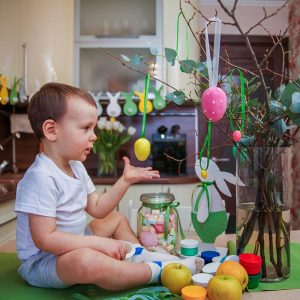

Why are appropriately stimulating environments and meaningful engagement and interactions are encouraged for young children?
Just as adults have preferences, young children are developing preferences for what they see, hear, feel, smell, and taste. Parents should pay attention to what their child enjoys and what' s/he steer clears of. Parents, needs to be sensitive to these differences and curate activities to accommodate their child’s sensory preferences as it leads to their child’s perceptual development (taking in, interpreting, and understanding). Based on their perception, children learn about their world by engaging their senses (ability to see, hear, smell, taste, and touch) with their surroundings. As they grow sensory inputs are used to manoeuvre their action (motor development) and behaviour (emotional development):
- Child can perceive how to move his/her body around an object of obstacle
- How to delicately hold fragile items, or put in all strength to lift heavy objects
Sensory Processing & its effect on learning
The Learning Pyramid offers a simple explanation for the way in which a child’s senses and skills are linked. If the child’s nervous system and sensory processes don’t operate as they should, there is ‘knock on effect’ all the way up to the top of the pyramid.
“Pyramid of Learning” is a way of looking at the whole child and helps parents to understand where the child is in terms of need for developmental support.
The environment that the child is in, as well as the relationships s/he has with parents and others, will probably always be a factor in how s/he will manage the social and emotional demands of the world.
For the child to be able to learn and master ‘higher order’ skills like speech, language, problem solving and critical thinking, their sensory integration needs to work well.
And if it does not, then communication, behaviour and learning problems can occur.
SHARE
Share on facebook
Facebook
Share on twitter
Twitter
Share on linkedin
LinkedIn
Share on whatsapp
WhatsApp
Last Chapter
Next chapter