
Toddlers – PSED
Social Development in Toddlers
Chapter 5.3
Share on facebook
Share on twitter
Share on linkedin
Share on whatsapp
It’s been quite some time since 28-month-old Reeja’s parents have been trying to toilet train her. Toilet training involves three domains – the physical (control), the cognitive (understanding) and the emotional (willingness).
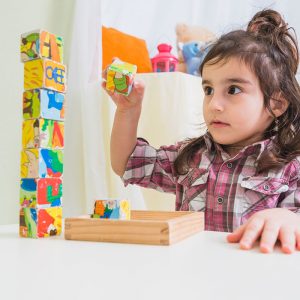
Reeja had sharp cognitive skills evident from her love for solving puzzles and optimal control of bodily movements as she was efficient at doing age-appropriate chores at home, or keeping her toys in place.
So here her ‘willingness’ to get trained was what needed to be worked upon. Her mother got her some books that described how using the toilet is a sign of growing up. In order to not seem pushy, they began to let her explore the flush, the hand washing and the need for no diapers. Her mother even demonstrated her the use. This activity prolonged for a couple of days, until one fine day, Reeja came to her mother and expressed her desire to use the toilet. There was no looking back from there…
Let’s Reflect
The parent’s goal is to get their child’s movement towards independence working. for their development. You need to be thoughtful and avoid power struggles. Your child should see you as a support to her own developing capabilities and independence.
Stage 2 of Erikson’s theory of psychosocial development: Autonomy
By the second year, the growing child attains a new sense of independence through movement. They thrill of moving around helps them perceive their individuality. Gradually the confidence and urge to self-help develops. If they don’t learn some degree of self-sufficiency, they come to doubt their own abilities and feel shame.

Early Social Behaviour:
You offer them bananas; they demand an apple…
You take out a blue t-shirt, they pull out a red one…
Toddlers are famous for frequently asserting “NO”. It is their way of pushing for separateness. They are trying to differentiate themselves from others, by what outwardly seems to be an act of defiance.
“I will do” is also a drive having the same agenda: drive for independence.
In order to capitalise this drive for independence Parents need to set up situations for their toddler to be able to do what he/she wants to do.
The power of Everyday Interactions:
Under similar common scenario:
“As soon as his mother comes, Dhairya begins his tantrums with food, complains his grand-mother.”
“Arrival of Dad seems to be the green signal to jump up on sofas and beds!”
Parents often feel that they are doing something wrong, as their child seems to be more defiant and rebellious in their presence! Please do not. By toddlerhood the bond between the parent and the child is not just deep but immensely passionate. The child feels most secure and free to express himself/herself in their presence.
Moreover, rejecting behaviours are not just normal, but in fact a positive sign, for toddlers to exhibit. Such reactions bring to picture the child’s growing sense of autonomy and a strong sense of separateness.
Limits for Toddlers:
Limits provide a sense of security to toddler, just like swaddling does to a newborn. Because boundaries of behaviour are not tangible, toddlers are compelled to bump up against a limit just to figure out if it really exists and to make sure it will hold!
Sounds familiar?
– Moving couple of steps towards those “stay away” low lying delicate pottery, while looking towards you for an obvious ‘NO’ or
– Asking to eat that 4th chocolate in the fridge, even though s/he clearly knows it is out of limit!
The word discipline in context to toddler age immediately brings forth behaviours like biting, hitting, throwing things around, shoving, pulling hair and destroying toys and materials. Reasons can be:
- Out of Anger
- Out of curiosity
- Or as an effort to draw attention
The objective is to prevent the trigger to such aggressive (intent-to-harm) behaviour, and not just dealing with the situation So parents, beware of advice that advocates any one simple solution. It’s time to tune-in and try figuring out:
- Possible origins of such behavior
- The message behind the behavior
- The environment may be a contributor towards the behavior
- Possibility of an adult’s behavior that may triggers the aggression
- What channels or resources does your toddler has to express his feelings?
Being a parent is rewarding but often demanding. However, knowing what your child is undergoing is a normal part of development, can be very reassuring.
Having high levels of self-awareness and empathy enables parents to ‘tune in’ and respond in a reflective rather than an impulsive way. The relationships you establish with your child and the learning opportunities you provide will help your young child to develop the personal, social and emotional skills.



SHARE
Share on facebook
Facebook
Share on twitter
Twitter
Share on linkedin
LinkedIn
Share on whatsapp
WhatsApp
Last Chapter
Next chapter