
Toddlers – Physical Development
Supporting your Toddler’s Motor Skills
Chapter 5.8
Share on facebook
Share on twitter
Share on linkedin
Share on whatsapp
Motor skills and cognitive processes influence each other and are manifested mostly through behavioral motor modalities. Hence, apart from the maturational level of the Central Nervous System, other variables influencing motor behaviour include:
– emotional state of the toddler,
– the degree of motivation,
– cognitive awareness,
– the toddler’s posture,
– muscle strength, and
– biomechanical leverages.
Let’s Reflect
What can parents do to support their child’s motor development skills?
Provide lots of safe, fun, supportive opportunities to practice during playtime.
What You Can Do to Nurture your Toddlers’ Physical Development
1. Enable Spatial Awareness
Try to maintain clutter free/open spaces for your beginner to toddle without bumping into things. Help your child get familiar about spatial relationships and how to move themselves up and down. You can gradually introduce sturdy short inclined surfaces (just DIY), low stepping stools, and in fact plan a sensory stimulation activity for his/her feet. A sturdy chair with arms will help your toddler learn how to get in and out of the sitting position.

2. Ensure ample opportunities to climb
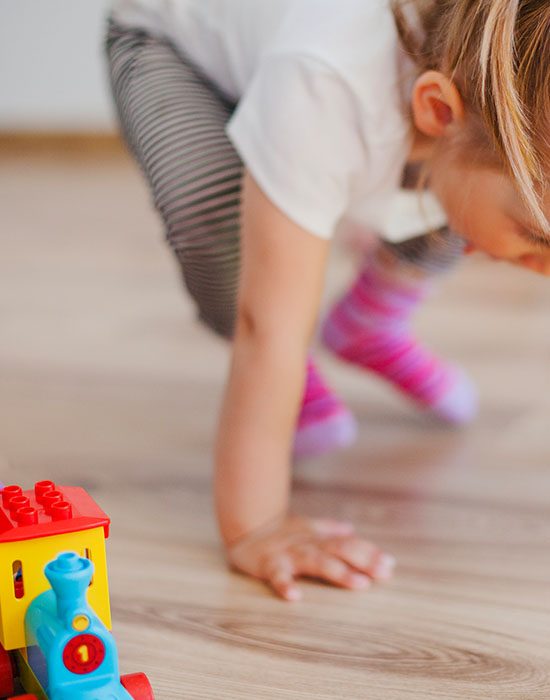
Toddlers practice their large motor skills by climbing on everything. Have safe, well-padded climbing resources like cushions, mats, stuffed toys. Building toddler obstacle courses with pillows or baskets, which the child has to walk around. These will not only give them safe places to practice but also reduces the chances that your toddler will climb on tables, chairs, bookshelves and other furniture.
3. Toddler years are mostly about stack, fill and dump
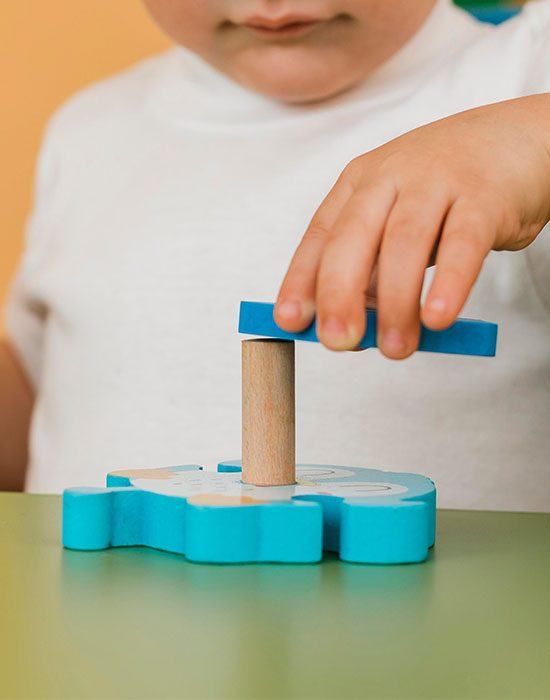
Household items draw him/her naturally, more than toys. So, what better way to practice fine motor skills! Make available objects like cardboard boxes, buckets, water, sand, lentils, empty tins, kitchen ladles, colanders, lacing shoes, etc. and watch your toddler fine tune his/her finer muscular strength. Overlooking the mess is the only way to ensure development of your toddler’s fine motor skills.
4. Child-proof your home
Toddlers need a place that is safe to explore and experiment. Get down on your knees so you can see what your toddler’s view will be. Remove everything breakable or dangerous from his//her reach. Cover electrical outlets and cords, lock up household cleaning, laundry, lawn care and car care products; use safety gates wherever necessary; and always lock doors to outside and basement.
5. Encourage Movement:
Play chasing games, hide and seek, peek-a-boo. Play soft music to encourage listening and moving.
– Provide toys your toddler can push or pull safely. Provide riding toys, such as a tricycle
– Kick, roll and throw balls with your toddler. Encourage him/her to run and kick it.
– Encourage your toddler to drink from a cup and use a spoon, no matter how messy.
– Blow bubbles and let your toddler pop them.
– Ask your toddler to carry small items for you once he/she walks well.
– Visit parks, playgrounds and large indoor play spaces where your toddler can run and climb on playground equipment.
– Dance with them to a rhyme or music and introduce games like “Freeze”.
– Take your toddler to parks to run and hike on nature trails. Teach your child how to “pump” his/her legs while on a swing.
– Encourage your toddler to open doors and drawers; ask him/her to turn pages in a book while you are reading.
– Hold your child’s hand going up and down stairs, or encourage him/her to use the railing.
Most Importantly “Do Not Push”. Development will happen on its own, the style and pace of whicg is unique to each child. Celebrate success each time your toddler beams ear-to-ear at his/her achievements – can be the ability to use a fork to finish his bowl of apple cubes, dumping his clothes in the laundry basket, stacking books onto the shelf or has just about managed to get down those two stairs on the way to the restaurant!
Of course! your encouragement is sought for, but it is important to hold yourself from rushing into the process. Savour the journey and follow your child’s lead into the next stage of development as and when s/he is ready for it.


SHARE
Share on facebook
Facebook
Share on twitter
Twitter
Share on linkedin
LinkedIn
Share on whatsapp
WhatsApp
Last Chapter
Next chapter