
Preschoolers – Math
Talking Math with your Preschooler
Chapter 6.14
Share on facebook
Share on twitter
Share on linkedin
Share on whatsapp
The most effective way to teach preschoolers mathematical skills is through PLAY! All play experiences have hidden opportunities for learning math. So always try to introduce vocabulary and constantly ask questions during play.
Let’s Reflect
We can make the math that occurs in daily life visible to children through math talk. Each day offers us countless opportunities to help children deepen their understanding of math concepts
How can parents support preschooler’s math-learning opportunities?
1. Shapes & Geometry:
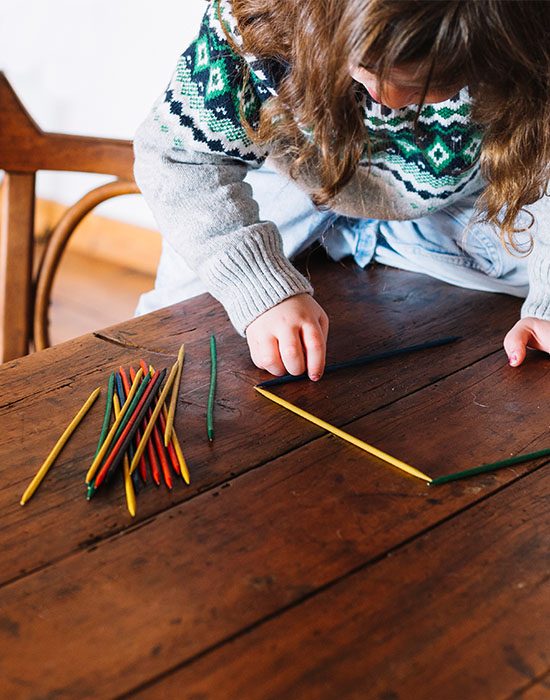
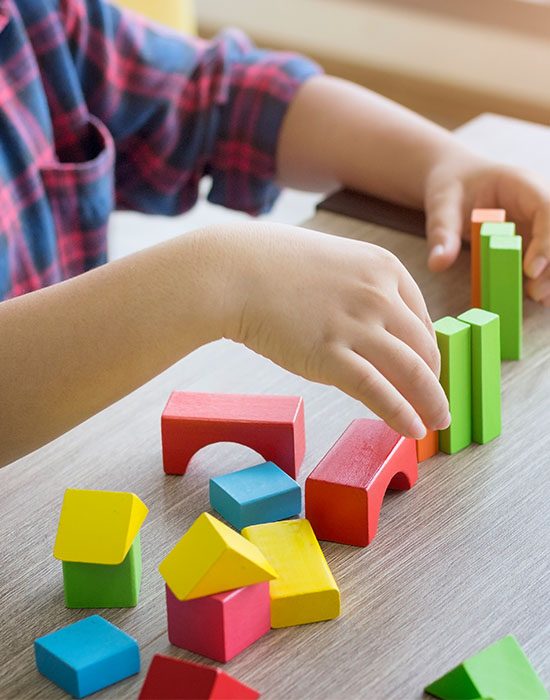
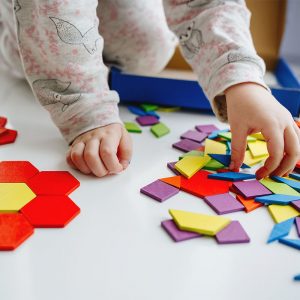
Playing with shapes, puzzles, pegboards familiarises your child with basic geometric shapes, as well as their properties i.e. a triangle has 3 sides, a rectangle has two long and 2 short sides. Next make it a game to guess shapes of objects around the house, or a restraint you visited like a circle in clocks, coins, triangle on the table cloth print, rectangle lunch box and so on.
Puzzles & pegboards are excellent mediums for developing visual perception along with building your child’s understanding of geometry.

2. Spatial Sense:
Building forts and climbing inside them, crawling under tables/chairs, tunnels, stacking objects or blocks is the first step in a child’s learning about space and shape. These early play sessions are a must!
Use spatial language to discuss the placement of pictures. Play treasure hunt. Give or ask related clues such as: “Where is the bunny? It is near the cabinet. Is it under the bed?” Or reference sizes by asking, “Is it inside the big box? Is it behind the door or under the mat?
3. Number Concept:
Start with small numbers (no more than five) and add a few as your child is ready for a challenge. Playing with manipulatives like beads, blocks, finger foods happen to be the first step in building a number concept.
Parents can focus on counting as purposeful. Eg: there are two cookies for a snack” rather than “there are cookies for a snack.” Count objects in everyday contexts such as buttons in a shirt, number of bowls needed to serve the ice-cream to all friends.
4. Basics of Capacity:
Providing containers of different sizes and shapes during play in sand-pits or baths, allows your child to discover the basics of capacity.
Baking is another excellent medium to introduce your child to units of measurements and quantities. Let your child be involved in measuring the ingredients.
5. Measuring Objects:
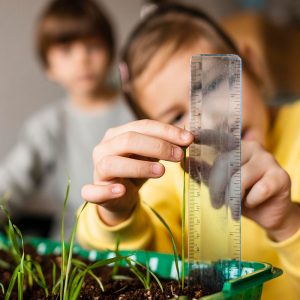
Children must first learn to measure length using non-standard items before they can be introduced to standard measurements. Use a rope, thread, block, palm of the hand, foot and other mediums to measure certain objects, like carpet, length of the carton box, depth of water in the bathtub etc.
6. Time to talk about ‘time’:
Find opportunities daily to talk about time. Use the daily routine as a starting point. E.g.: Let’s go to the park at 7 p.m.; Your swimming class is at 10 am in the morning.
7. Introducing weights:
Begin with letting them hold and differentiate between heavy and light objects. Gradually let them explore the concept on a balancing beam with household objects. Grocery Shopping is the perfect role play for this!
Children often resort to guessing the solutions without having any idea of what the problem is actually about. Develop your child’s critical thinking skills, for them visualize the solutions the logical way (e.g. it says more so I should add).
The most effective way to prepare your child to acquire the zeal & ability to solve problems is by enabling him/her with ample opportunities to actually solve real problems!

SHARE
Share on facebook
Facebook
Share on twitter
Twitter
Share on linkedin
LinkedIn
Share on whatsapp
WhatsApp
Last Chapter
Next module