
Toddlers – Math
Talking Math with your Toddler
Chapter 5.13
Share on facebook
Share on twitter
Share on linkedin
Share on whatsapp
Following are the two pillars of math achievement: (Cheng & Mix, 2014; Gunderson, Ramirez, Beilock, & Levine, 2012).
Numerical thinking: Introducing number talk, through social interactions during play and everyday activities, facilitates the development of foundational numerical concepts.
Spatial thinking: There is evidence that spatial play— for example, play with puzzles and blocks—as well as exposure to spatial language are important in building spatial skills.
Therefore, a toddler’s environment significantly contributes to inciting numerical thinking as well as building strong spatial skills!
Let’s Reflect
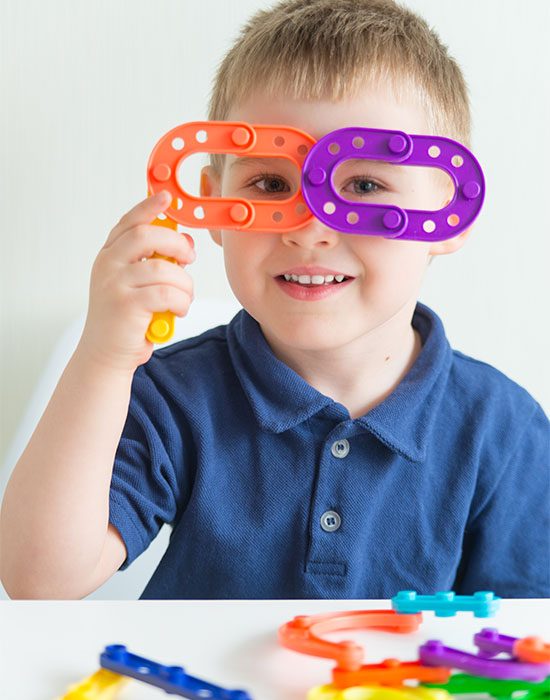
Young children pick up early math skills by building on their natural curiosity in everyday playful activities…
Some ideas to playfully introduce early math skills to toddlers:
Talk with your child about each shape—count the sides, describe the colors
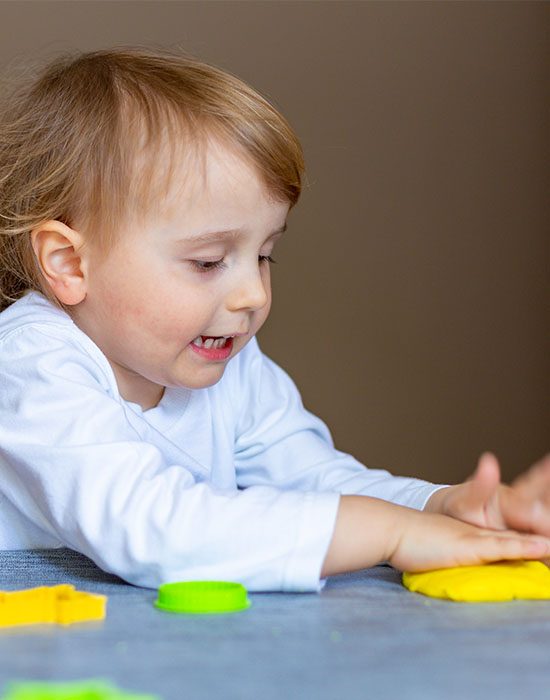
- Cut out shapes using playdough.
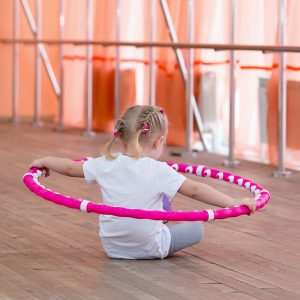
- Play with the circular hula-hoop!
- Give choice between rectangle or heart-shaped cookies
- Notice the red triangle sign board during a walk down the lane
- Let’s cut your square sandwich into triangles


Concept of Numbers:
Besides counting, ensure your toddler’s understanding of quantity, order, ways of representing numbers, one-to-one correspondence (that 5 objects correspond to number 5).
– There are 4 pigeons sitting on the One flew away. And now there are only three left!
– Counting forward and backwards while in a lift. 0,1,2,3…. Or 5,4,3,2,1,0
– How many crayons are there in this box? Let’s count.
– You have 5 candies!!! and I have only one
– Teach your 3-year-old about how every house/car has a number and the number of your house/car
– When you are distributing items, emphasize the number concept: “One for you, one for me, one for Daddy.”
Spatial Relationships:
No, It’s not heavy-duty physics! It is about giving a know-how about the physical relationship between oneself and other objects and the relationships between objects.
– Our car just passed under the bridge!
– It gets dark when the train passes through a tunnel
– The clouds are high up in the sky
– Let’s jump across the muddy puddle
– Can you hit the balloon higher than me?
– Nesting boxes and cups helps the child understand the relationship between different sized objects.
– Do you think you can fit inside this empty carton box?
Measurement:
Size, weight, quantity, volume, and time.
– Notice the world around you:
– Oh! You are taller than the bush!
– This small fat book is heavy, but holds this big thin book. It is not!
– We are going to your friend’s birthday party tomorrow afternoon.
– Let them fill, stir and pour. Through these activities, children learn, quite naturally, to count, measure, add, and estimate.
– Play minute to win games. Use an hourglass, stopwatch to keep a tab on time. This helps children develop a sense of time.
Identify and Sort Pattern:
Basic building block for algebra!
– It is about recognizing relationships and/or creating repetitions of objects, colours, lines, textures, or sound
– It is also, about understanding and mathematically describing how events occur/change with time
– How about sorting grandma’s box of buttons: oval, diamond, big, small, the shiny ones, the two-coloured buttons and so on…
– Collect ice-cream sticks to develop and replicate patterns!
– How about creating your own steps to the beat of a song!
– I put the toys into the tub of water and you take them out one by one and dry it out with a towel.
– Note similarities and differences (the birds have wings and therefore, can fly. Our bingo (pet dog’s name) is not a bird as it does not have wings but four legs.
– Mess can be fun: The box of macaroni fell! Let your child derive different patterns or designs out of it, while you enjoy a hot cuppa tea! (Supervise your child carefully during this activity to prevent choking, and put away the item when you are done.)



SHARE
Share on facebook
Facebook
Share on twitter
Twitter
Share on linkedin
LinkedIn
Share on whatsapp
WhatsApp
Last Chapter
Next Module